

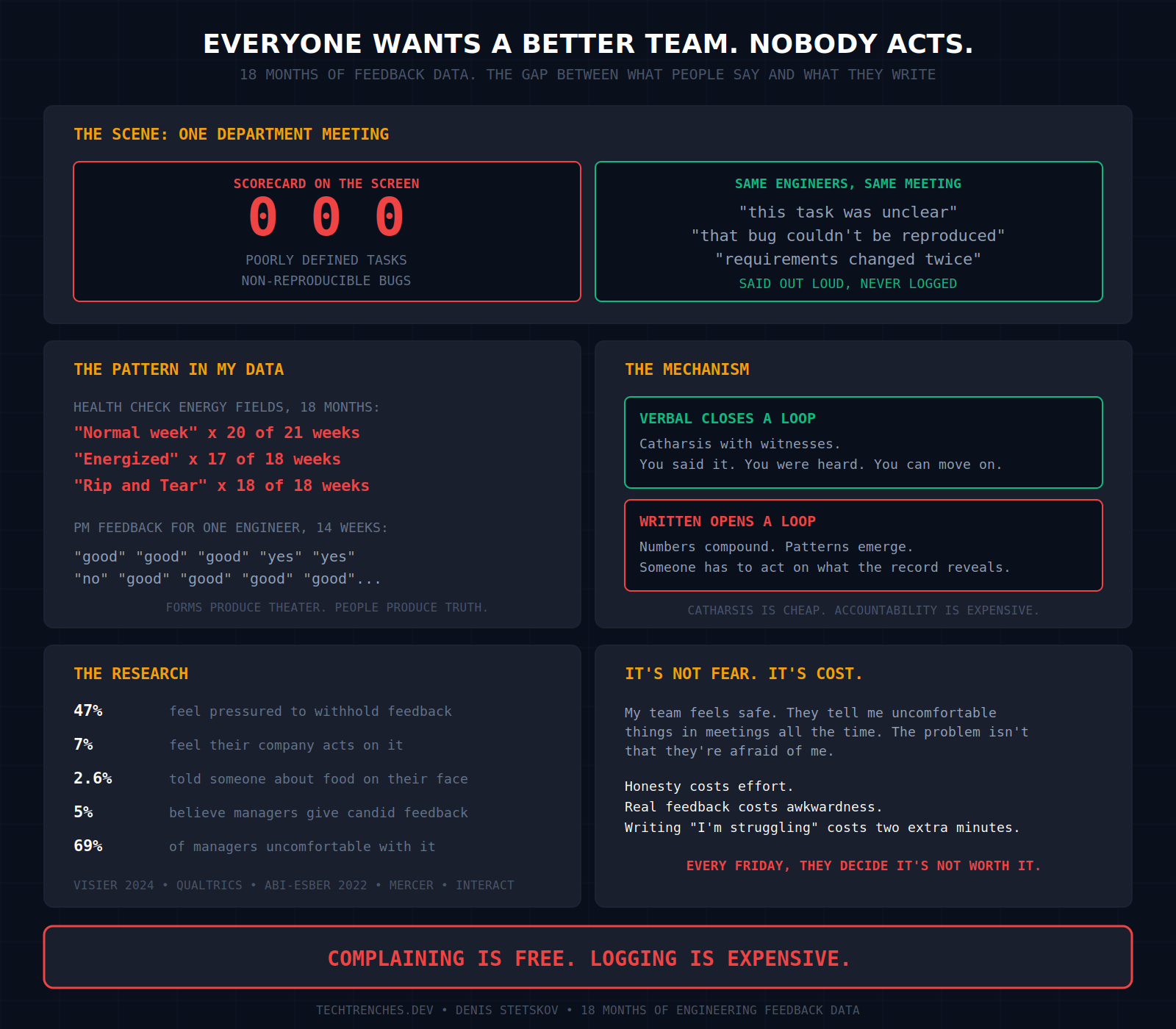
We track two scorecard metrics in our department meetings: how many tasks were poorly defined, how many bugs weren’t reproducible. Engineers own the data. They’re supposed to log the count whenever they hit one. Three weeks of tracking before the tool broke. The numbers across the board: zero. Zero poorly defined tasks. Zero non-reproducible bugs.
Then we get to the department meeting. The scorecard goes on the screen. Zeros across the board, everyone nods. The discussion opens up, and within minutes the same engineers are saying out loud: this task was unclear, that bug couldn’t be reproduced, requirements changed mid-sprint twice this week. They say it casually. In conversation. As a follow-up to the very metric they just reviewed at zero. And next sprint they’ll log zero again.
That gap is the entire story.
The Forms Are Silent. The People Aren’t.
I’ve been running weekly health checks on my team for 18 months. Energy level, stress, meeting hours, context switches, one open-ended question. Hundreds of data points per person. Once I noticed the scorecard pattern, I went back through all of it.
One engineer reported “Normal week” as his energy for 20 out of 21 weeks. His stress field bounced between “Rip and Tear” and “Hell on Earth” the same period. Some weeks were clearly harder than others. The energy field? Copy-paste. Same answer. Every Friday.
Another engineer: “Energized, could climb mountains” for 17 out of 18 weeks. Either he discovered the secret to permanent workplace happiness, or he stopped reading the question around week three.
A third: “Rip and Tear” for 18 straight weeks. Eighteen identical data points is not feedback. It’s a checkbox.
PM feedback runs the same way. One PM’s responses for an engineer over 14 weeks: “good”, “good”, “good”, “yes”, “yes”, “no”, “good”, “good.” That’s not feedback. That’s a pulse check confirming the person is alive. Different PM, different engineer, same problem. Generic words filling required fields.
But here’s the thing. Every one of these people, in the right conversation, can tell you exactly what’s wrong on their team. In a DM. In a side conversation after a call. In the unstructured five minutes when someone with enough authority sits down and physically drags it out of them. The information exists. It just won’t go into anything that looks like a formal channel. Retros are the same silence as the scorecards unless a strong facilitator pulls problems out of people one by one. Forms produce “normal week.” Surveys produce green dashboards. The honest answer only shows up when no one’s writing it down.
Complaining Is Free. Logging Is Expensive.
When you complain out loud in a meeting, you’re performing dissatisfaction. You said the thing. You were heard. The room reacted. Whatever frustration you brought into the meeting got released into it. You can move on. Verbal complaining closes a loop. It’s catharsis with witnesses. By the time the meeting ends, the emotional cycle is complete and the conversation has moved to the next agenda item. Nobody is going to dig up your remark next quarter.
When you write a number into a scorecard, you open a loop. The number doesn’t dissolve at the end of the meeting. It sits in the tool. Next sprint there’s another number next to it. Then another. Pretty soon you have 23 poorly defined tasks across a quarter, which is no longer a complaint. It’s a case. Someone has to either fix the underlying problem, or push back on the data, or have an awkward conversation with the PM whose tasks generated those numbers, or admit that the metric isn’t working and kill it. Writing creates an open ticket. Open tickets demand action.
This is why the scorecard stays clean even when the same engineers are openly describing the problem in the same meeting. Talking about unclear tasks in conversation gets the frustration out of their system. Logging the count would commit them to a position they’d have to defend, week after week, until something actually changed or somebody got hurt. Complaining is free. Logging is expensive.
A 2025 study in the Journal of Organizational Behavior interviewed 98 people across three organizations about negative feedback. One quote captured the math exactly: “I really balance in giving negative feedback. Is it worth for me to share or not? It is easier not to share than to share.”
That’s my whole team. Every Friday.
It’s Not Fear. It’s Cost.
The standard answer here is psychological safety. I’ve read Edmondson. I believe it matters. But she said this herself: psychological safety without accountability creates a comfort zone. People feel safe but don’t push for excellence because there’s no cost to staying silent. She’s been explicit about the misuse: “People are starting to use the concept as a weapon. That’s completely incorrect.”
My team feels safe. They tell me uncomfortable things in meetings all the time. The problem isn’t that they’re afraid of me. The problem is that being honest costs effort, real feedback costs awkwardness, and writing “I’m struggling” instead of “normal week” costs two extra minutes nobody wants to spend. Every Friday, they decide it’s not worth it.
The research confirms this is universal. A 2024 Visier survey found that 47% of employees feel pressured to withhold honest feedback. Only 7% feel their company acts on the feedback it gets. The standard read of these numbers is sympathetic: people stop being honest because nothing changes. I think that’s only half the story. People stop being honest because they confuse “I haven’t seen the change yet” with “nobody’s listening.” Two or three weeks pass without a visible result and they decide the loop is dead. They don’t account for the fact that decisions take time, work happens behind closed doors, other priorities compete for the same hours, and the change they wanted might already be in motion three layers up. They just stop. A 2022 study found only 2.6% of people in a field experiment told someone about visible food on their face. People want honest feedback. They just don’t want to be the one giving it.
PM feedback is even worse. When an engineer on my team got a new PM, his scores dropped from 3.71 to 2.43 in a single month. Same engineer, same work, same projects. The previous PM had rated “Always” across the board for months. No friction, no conversation, path of least resistance. The new PM started writing “Sometimes” and “Often.” The engineer’s performance hadn’t changed. The PM’s tolerance for awkwardness had. Only 5% of employees globally believe their managers give candid feedback. 69% of managers say they’re uncomfortable communicating with employees. Your PM isn’t lying maliciously. They’re avoiding a conversation that feels like conflict.
The Leadership That Doesn’t Exist
This isn’t a tool problem. The tool is fine. Five questions, two minutes, every Friday. The scorecard was two numbers. None of this is hard.
This is a leadership problem at the individual level. Not management leadership. The willingness of every person on a team to take ownership of the environment they work in. To fill out a health check honestly instead of copying last week’s answer. To write the unclear-task count even when it’s awkward. To tell a PM “your feedback is useless, give me something I can act on.” To be the first person in a meeting to say the thing that needs saying and then be the first person to write it down where it can’t be ignored.
Almost nobody does this. Not because they’re bad people, not because they don’t care, but because being the person who creates a record is the person who has to deal with what the record reveals. It’s easier to let it stay verbal. It’s easier to let someone else go first. It’s easier to ship the comment in conversation and then click “Normal week” in the form.
At the end of every week I feel like I’m running a kindergarten. One engineer doesn’t flag a problem at all. Another flags it but to the wrong person. They come to me about a misunderstanding with a colleague instead of going to the colleague directly. Now I have to walk over, decode what actually happened, and broker the conversation two adults could have had themselves in five minutes. Triangulation as the default communication pattern. Coordination overhead generated entirely by adults who refuse to act like adults.
I wrote about our feedback system and 1:1 formula before (in hindsight, the titles were too loud, lol). Those articles described the mechanics. Eighteen months later, what the mechanics revealed is that systems don’t create culture. People do. And right now, most people in most companies are choosing the version of themselves that protects the relationship over the version that improves the situation. This isn’t an engineering problem. I just happen to run an engineering team, so this is where I see it. The same dysfunction is in every department, every industry, every workplace where adults are asked to give honest input about their environment.
What I Got Wrong
Will I keep running health checks? Yes. I’m too stubborn to admit that I failed. Am I frustrated? Absolutely. Did I fail as a manager? Yes. Because I wasn’t able to teach my people that change begins from us, not from a process or a tool. Will I repeat four times per month that filling out the form honestly matters, that the comment field exists for a reason, that the scorecard wants the real number? Yes. Every single month.
Everyone wants a better environment. Almost nobody wants to be uncomfortable enough to build one. I’ll keep pushing until they do or until I run out of stubbornness. So far, the stubbornness is winning.
If your feedback systems are producing theater instead of signal, hit reply and tell me what you’ve tried. I read every response.
PS. The comments on the last two articles meant more to this old man than you'd think. By the time this one publishes I'll be on vacation, but please keep them coming. I'll see every reply when I'm back and I promise to write back to each one.
You may have inadvertently discovered a metric for measuring apathy. Here's a thought: since engineers are analytically minded, any system designed to measure our performance is going to analysed and mitigated. When management started using #failing regtests to beat engineers over the head, guess what - tests that are known to fail get removed from the weekly run. The hilarious end-state in my workplace is that due to compute farm time-cost metrics, this has also become official enough to be automated in the infrastructure that runs the tests.
Even though your objective is actually to look after the well-being of your team, the data-gathering may be sending a message of "here's another manager who will use incomplete data to make decisions that increase process and adversely affect my job satisfaction".
Overall - and yes this is an engineer's perspective - it is more helpful if team members have the freedom to be completely open with you in conversation, and young engineers are actively encouraged to be open like this. Questions like looming burnout can be addressed indirectly by asking about activities outside work ("did anything fun last weekend?").
That does place a burden on you the manager, to amass and filter circumstantial evidence, but I think team leadership works best when based on large amounts of low quality info, than systematic gathering & analysis of data that are incomplete or liable to manipulation.
But... at the end the day an engineer like me is expecting my manager to develop people skills so that I don't have to!
I'm glad a colleague sent this one along for me to read. Your framing of complaining as a closed loop and logging as an open ticket is one of the cleaner distinctions I've read on this dynamic.
For me, it's about the neuroscience underneath it. When someone vents in a team meeting, three chemicals light up quickly: dopamine from the validation and recognition in the room, cortisol released as stress exits their system, and oxytocin from the social bonding that comes from sharing frustration. That's a powerful cocktail. Logging a number into a scorecard offers none of that. No reward, no release, no connection. Just an open ticket and "deferred accountability".
So the gap or the problem you're describing is really three-fold: 1) a courage problem; 2) a culture problem, and 3) a design problem. The verbal channel is neurologically rewarding right now. The written channel? Well, that just asks people to delay gratification for an outcome they may not trust will come.
The culture piece you raised near the end is where I think the real work lives, and one in which systems do not create it. Leaders who understand why the meeting feels good can start designing environments where the documentation feels worth it, too.
Great piece. Genuinely.