

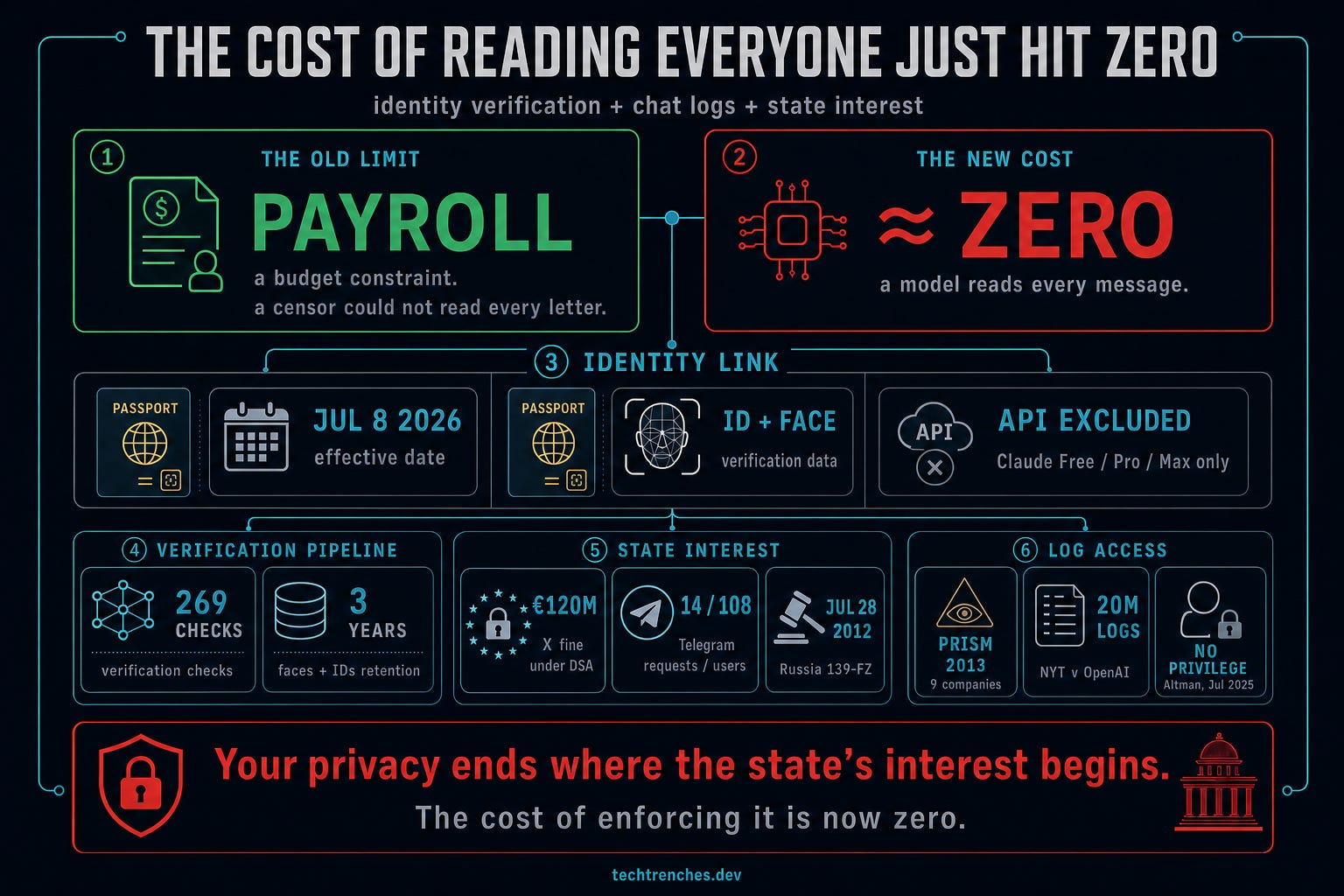
On July 8, 2026, Anthropic can ask for your passport. The updated consumer privacy policy adds a category it calls Verification Data: an image of your government ID, the information printed on it, a photo or video of your face, and a facial geometry template. It covers Claude Free, Pro, and Max. It does not touch the API. A vendor named Persona collects the documents and the selfies, processing them on Anthropic’s behalf as a service provider rather than an independent data controller. The company says only a flagged subset of users will ever see the prompt.
Persona itself was caught in February with its government dashboard exposed on a public endpoint, the code showing a pipeline of 269 verification checks and three-year retention of faces and IDs.
Handing over a face is trivial. What sits behind it is a year of questions you would never put your name to, and reading all of it just turned cheap.
Payroll was the ceiling
For most of history, surveillance ran into the same wall: payroll. A Soviet censor could open your letter. He could not open everyone’s letter, because steaming envelopes takes hands and there were never enough hands. The Stasi got closest, running files on a share of the East German population large enough that historians still argue the exact fraction, and it took warehouses of paper and a network of informants the size of an army to do it. The ceiling was human. Reading you cost a person a day, and a person’s day costs money.
What protected the ordinary person was the price of attention. You were boring, and boring was expensive to read.
AI removed the ceiling. A model reads every message at a cost rounding to zero, sorts them, flags the interesting ones, and never asks for a raise. The thing that made mass reading impossible was arithmetic, and the arithmetic just inverted. Two variables remain: who holds the data, and what they say when the state asks.
Refusal is the exception
EU Commissioner Thierry Breton sent Elon Musk a letter in August 2024 warning that a live interview with a US presidential candidate could trigger DSA measures against X. Musk refused. In December 2025 the Commission fined X roughly 120 million euros, and X is challenging it in court, the first legal challenge to a DSA fine. Whether the fine holds, whether X folds quietly later, we do not know yet.
The other response leaves no press release. TikTok rewrote its global community guidelines across 2023 and 2024 to satisfy DSA pressure, restricting categories of political speech worldwide, and users were never told that was the reason. It surfaced only because the US House Judiciary Committee subpoenaed the internal documents and published them.
Telegram is the cleaner case. A month after French authorities arrested Pavel Durov in August 2024 on charges tied to content on the platform, Telegram changed its terms to hand IP addresses and phone numbers to authorities on valid legal request, up from the 14 requests covering 108 users it had honored earlier that year. Durov framed it as global consistency. I read the timing as a man doing the math after four days in custody, and I will mark that as my read, not a proven quid pro quo. What he was actually shown, and what was actually agreed, never became public. That is the part that should bother you, not the man.
The faster route skips the asking and writes the apparatus into law, justified by something nobody can vote against. One country already ran that justification all the way to the end.
Same rails, better manners
Russia stopped bothering with manners early. Vladimir Putin signed Federal Law 139-FZ on July 28, 2012, an amendment to the statute on protecting children from harmful information, child abuse imagery, drugs, suicide methods. It created a single national registry of blocked sites under Roskomnadzor, in force that November. By the end of 2013 the Lugovoi law had bolted extrajudicial blocking for extremism and calls to protest onto the same registry, and by 2022 it was the instrument shutting down independent outlets and war coverage. The children were the door the apparatus walked through.
The democracies are building the same lever with better manners. The UK Online Safety Act and the EU Digital Services Act are sold as child safety, and so is every age-verification law in the current wave. Strip the packaging and the demand is the same: identify the user, filter what they see, and on order, block. Brussels runs it with judicial review and oversight that Moscow never bothered with. The lever underneath is identical, and the difference is how many press conferences you hold about protecting kids while you install it.
I have watched a ban fail
That excuse is the one nobody can vote against, which is the whole point of reaching for it. I am against bans, and Ukraine taught me why. In June 2022 the parliament banned public performance of music by post-1991 Russian artists, in transport, restaurants, and on air, with an exemption list for anyone who condemned the invasion. Ukraine at least said the real reason out loud, in the bill’s own note: Russian music makes a Russian identity more attractive and feeds separatist sentiment. Identity and security.
The teenagers play it on their speakers anyway, the music of the people sending the missiles, while the missiles are still landing. If that does not break the habit, a fine printed in the official gazette will not. A ban does not cure the taste, it drives it underground and strips the brakes off it. What reaches a kid is whether the people around him handed down an identity strong enough to make the choice obvious. That is slower than a ban, and harder, so we pass bans instead.
When a government tells me it needs my passport to protect children, I believe the watching and not the reason. The child is the cover story, and they do not even need the new laws to do the watching, because they already did it once.
This already happened
In June 2013 the Washington Post and the Guardian published slides from Edward Snowden showing PRISM, a program under which the NSA pulled email, documents, photos, and chat logs from the servers of nine companies, Microsoft, Yahoo, Google, Facebook, PalTalk, AOL, Skype, YouTube, and Apple, running since 2007 under Section 702.
The protection users thought they had was a promise. By Snowden’s own account, the safeguards were policy-based, not technically based, and could change at any time. No court pried this loose and no audit caught it; it surfaced because one contractor copied 41 slides and got on a plane. That is the entire reason you know the program existed.
In 2013 the thing on the servers was your mail. The thing on the servers now is the log of how you think.
My own log
I use Claude every day, and the people around me use ChatGPT, Gemini, Perplexity. Same habit, different logo. We type things into it we would not say out loud: the health scare before the doctor, the money panic, the marriage that is failing, the thought we are ashamed of. No case officer ever had a source this candid, because nobody is interrogating us. We volunteer it, at speed, and we sign for it the same way, clicking accept on terms nobody opens and hitting submit before the sentence ends. The model ends up knowing us better than any file a state could ever open.
That log is not privileged. In NYT v OpenAI a federal court ordered the company to preserve every log, deleted conversations included, and ordered 20 million of them produced to the plaintiffs, who now want more. Anonymized, the court was told, but anonymized is a policy, not a wall. The retention is policy-based, not technically based, and we have heard that phrase before. On a podcast last July, Sam Altman said it plainly: talk to ChatGPT about the most sensitive thing in your life and there is no legal privilege protecting it, the kind a therapist or lawyer would have.
The verification on July 8 is the last lock clicking shut on a house that is already full. Nobody is reading my transcripts today, and that is not safety, only the absence of a reason to bother. The reason is the one part still missing. Everything else is built and waiting. I write the guardrails for this kind of system every day. I know how little it takes to flag a user, to watch what they type, to do it silently in the background, to log it off a chat summary and store it wherever suits. None of that is hard, and none of it is expensive anymore. That is the part I cannot unsee. As far as my own privacy goes, I read that as already lost, and I am telling you that as my read, not a slogan.
Whether you find out
The record points one way. TikTok’s global rewrite emerged under subpoena. PRISM reached daylight because one man copied the slides. Disclosure, when it comes, comes late and from the outside.
It always starts with the children. That is what earns the state the right to ask what you are hiding, because no one wants to be the person who said no to protecting a child. Wrap the taking of a freedom in care for a kid, and you reach the strangest part of all: people thank you for it. They line up to be read, and they applaud the hand that opens the file.
Every one of these came with a good reason. Terrorism, children, public safety. The reason was always real, and the freedom was always smaller afterward.
I am not asking them to stop. If the state and the companies it leans on want to watch, they have the tools and the cost is gone. I am asking them to drop the insult. Do not tell me it is for the children, for safety, for my own good. Name the thing. Watching is watching, and I can be told the truth about it like an adult.
The old line says your freedom ends where another person’s freedom begins. The new one is colder: your privacy ends where the state’s interest begins. The cost of enforcing that was the only thing that ever hid it. That cost is now zero.
This is depressing.
I cancelled my paid plan with Claude 3 weeks ago.
On July 7th, I will be closing my account entirely.
My very first encounter with a chatbot prompt was only 18 months ago. Skepticism fueled my ignorance before then. At that moment, entering my first prompt into ChatGPT, skepticism was briefly overcome by curiosity as I dived into the inner workings -- Transformers, Attention, Back Propagation. It looked like about 90% math, 10% computer science, in my novice estimation.
But still, the skepticism remained. It still remains.
I have developed software as a career just fine -- very successfully, in fact -- without AI, for several decades. I don't need coding agents, and I am more thankful with each passing day, that no one can force me to use them. And I most certainly don't need to surrender any more of my privacy to the likes of Dario Amodei or Sam Altman.
I have an "old" Mac Mini M1 sitting over there on the shelf. I'm sure I will do just fine with whatever open-source model it is capable of hosting.