

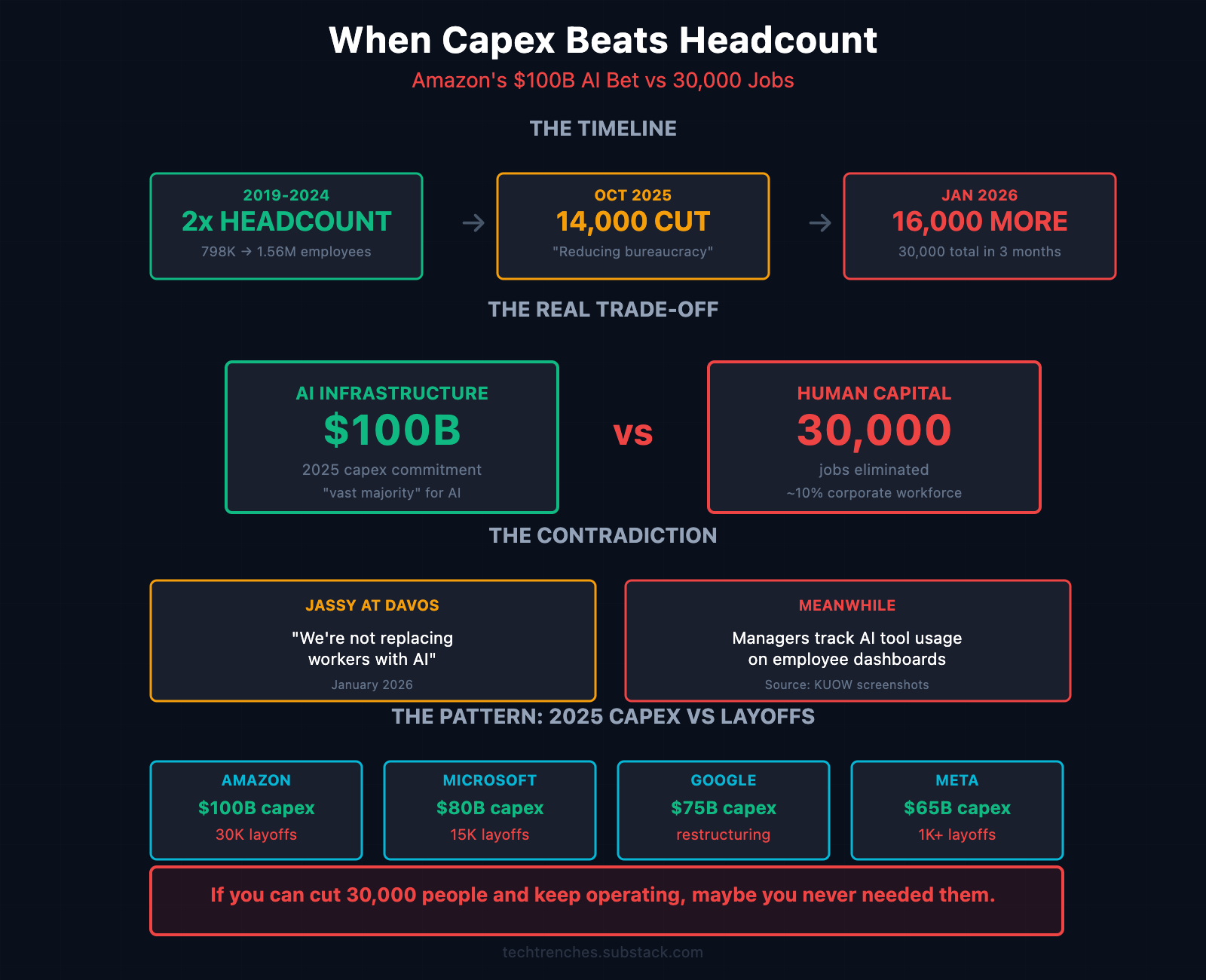
16,000 people. Wednesday morning. That’s 30,000 in three months when you count October.
Jassy calls it “reducing bureaucracy.”
The stock is up. Everyone’s wondering if the math actually works.
Here’s what nobody’s saying out loud: the moment your company decides to compete on AI infrastructure spending instead of engineering talent, people stop being assets. They become line items in the capex budget.
The Numbers
Amazon hired aggressively during Covid. Headcount roughly doubled between 2019 and 2024. The pandemic is over. Demand normalized. Rightsizing makes sense.
But that’s not what’s happening.
Amazon committed $100 billion in capex for 2025. The “vast majority” goes to AI infrastructure. Meanwhile, 30,000 people are gone.
I’ve watched this play out at smaller scales. First comes the board pressure: “Competitors are spending $100B on data centers. We need to match.” Then budgets freeze everywhere except capex. Then someone looks at the salary run-rate and realizes: $500M in annual engineering payroll could fund three more data centers.
The logic is seductive. AI is the future. We need chips. We can’t afford both.
The Dishonesty
Jassy at Davos last week: “We’re not replacing workers with AI.”
Here’s what employees are telling reporters: Screenshots show a dashboard that Amazon managers allegedly use to track how often employees use AI tools. Both employees interviewed said they expect AI usage to be factored into performance reviews.
Amazon hasn’t confirmed or denied these dashboards.
This is the pattern:
“We’re laying off 30,000 people to reduce bureaucracy.”
“Separately, we’ve invested $100 billion in AI infrastructure.”
“Separately, we’re monitoring which of you use AI tools.”
“Separately, we expect the remaining staff to do more with less.”
Then act shocked when engineers connect the dots.
I’ve lived through reorgs. Usually leadership is bad at communication. But it’s rarely this contradictory.
Here’s what honest would look like: “We’re reallocating capital from headcount to infrastructure. AI requires massive compute. That’s where we believe competitive advantage lives. Some roles will change. Some will end. Performance expectations are shifting.”
Brutal. But at least it’s real.
Instead, engineers get a memo about “removing layers.” Managers get dashboards to track AI adoption. Everyone pretends these are separate decisions.
That’s what kills morale. Not the layoff. The gaslighting.
What I Can’t Stop Thinking About
Since 2022, I’ve had open positions in my department. Constantly. Right now: four.
I hire slowly. Painfully slowly. Because for me, “right person, right seat” isn’t a LinkedIn slogan. It’s the difference between a team that ships and a team that churns.
I need engineers who are technically strong. But I also need culture fit. People who ask “why” before “how.” People who challenge decisions, not just implement them.
“Great vision with mediocre people still produces mediocre results.” Jim Collins wrote that. He was right.
So when I see companies treating people worse than AI tools, something doesn’t compute. I wouldn’t trade a single one of my engineers for the smartest AI on the market. Not one.
And here’s the thought I can’t shake: if you can cut 30,000 people and keep operating, maybe you never needed those positions in the first place. Maybe the problem isn’t “bureaucracy.” Maybe it’s that you hired without knowing why.
The Playbook Goes Normal
This isn’t unique to Amazon.
Salesforce froze hiring “because AI.” Duolingo laid off contractors and announced AI initiatives the same week. Meta is funding 100,000 GPUs while pledging to “reduce headcount and increase efficiency.”
The pattern is identical: announce the capex first, announce the layoffs second, pretend the AI tooling is unrelated.
In my own conversations with engineering leaders, the question has shifted. Six months ago: “How do we hire and retain talent?” Now: “How much can we cut headcount while maintaining velocity?”
The question changed faster than the strategy could justify itself.
I wrote about this in September: Big Tech’s $364 Billion Bet. They chose to spend rather than optimize. Now they’re choosing to cut people rather than audit their spending.
Nvidia calls this the “largest infrastructure buildout in human history.” That’s marketing. It’s also a forcing function.
If you don’t match capex spending, you lose the AI race narrative. So you cut people. So you can spend on chips. So you can match the narrative.
It’s a feedback loop. Feedback loops compound.
What Actually Works
If you’re an eng leader at a company considering layoffs or capex restructuring:
Be honest about the decision. Not in your all-hands. With your team. In 1:1s. “Here’s why we’re reallocating to infrastructure. Here’s what that means for you. Here’s how we’ll measure success.”
Then stick with that story.
Audit AI spending vs. actual revenue. Not potential revenue. Not TAM. Actual revenue. Amazon’s AI has generated... what exactly? Jassy hasn’t said. That’s telling.
If you’re asking people to use AI tools to pick up slack, say so. Build it into expectations. Train them. Measure productivity honestly, not just tool usage.
Remember: the engineers you’re keeping are watching. If you tell them “we’re not replacing people with AI” while firing 30,000 people three months into a capex blitz, they know you’re not being straight with them.
They won’t say it in the meeting. But they’ll start building escape routes.
The Uncomfortable Truth
The layoffs are fine. The infrastructure spending is defensible.
What kills engineering teams is the gap between what leadership does and what it claims to be doing.
Amazon just opened that gap very, very wide.
What infrastructure vs. talent decisions is your organization facing? Have you seen leadership communicate these honestly, or pretend they’re unrelated?
If this resonates, forward it to other leaders navigating similar tradeoffs. Sometimes the most expensive solution isn’t the most effective one.
Subscribe for weekly insights from the trenches of engineering leadership. Real problems, practical solutions, no corporate optimism.
Like & Share, I appreciate your activity.