

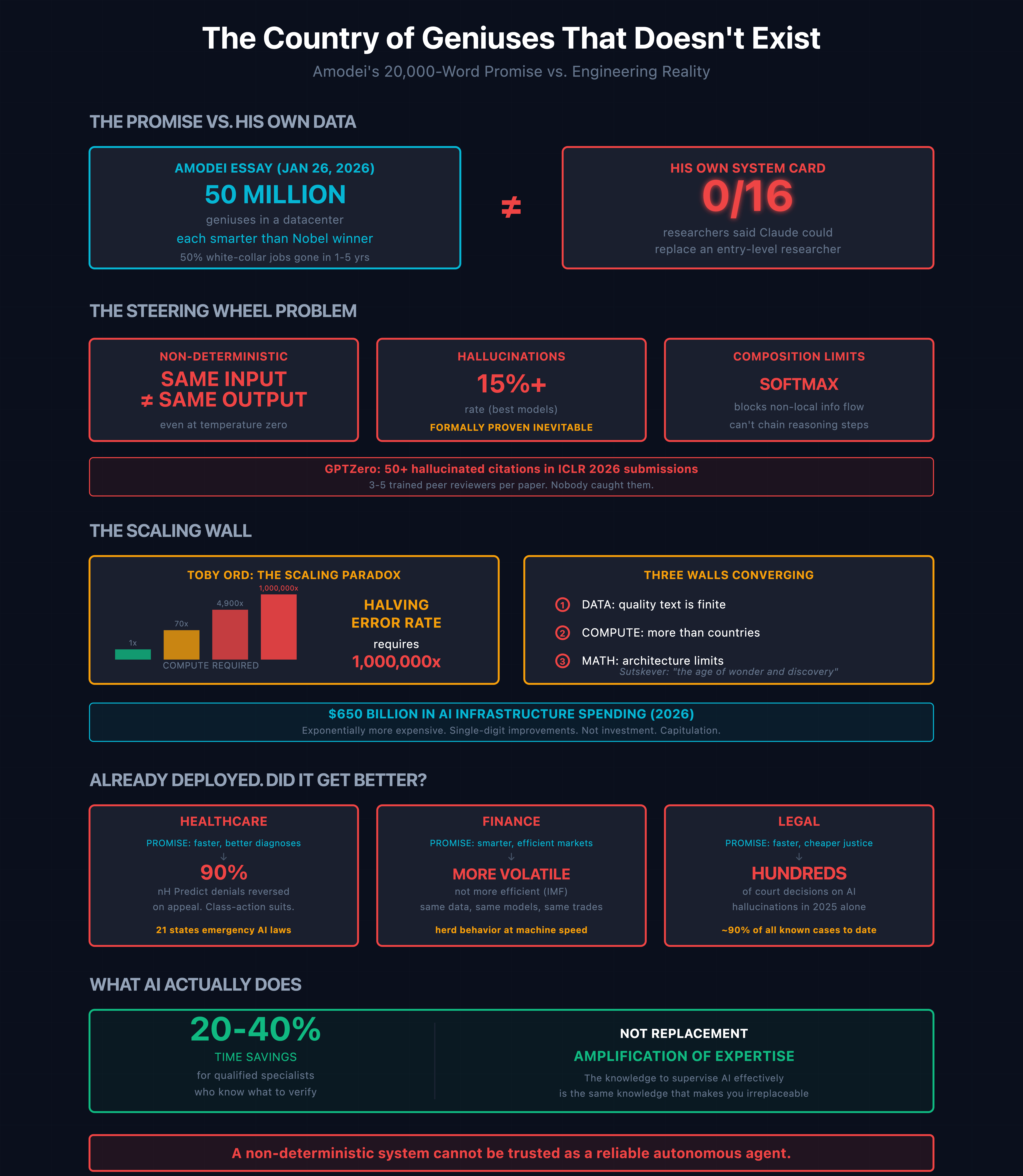
On January 26, 2026, Anthropic CEO Dario Amodei published a 20,000-word essay predicting a “country of geniuses in a datacenter” within 1-2 years. 50 million entities, each smarter than any Nobel Prize winner. 50% of entry-level white-collar jobs disrupted within 1-5 years.
5.7 million views on X. Standing ovation from investors. I only got around to reading it now. I have things to say.
I’m disappointed to watch Amodei and Anthropic slide into Altman-ism. Different prose, same playbook.
Maybe where the gods live, he’s right. Maybe in a world of perfect infrastructure, clean APIs, and unlimited compute, we’re ready to replace white-collar workers with AI. But where the rest of us mortals work, the situation looks completely different.
His own product’s System Card tells a different story. Anthropic surveyed 16 internal researchers on whether Claude could replace an entry-level researcher with three months of scaffolding. The answer was 0 out of 16.
Zero.
We’ve spent four years shipping AI integrations for clients. The models are impressive. They are not replacing white-collar workers. Not in 1-2 years. Probably not in 5. And the reasons are more fundamental than the industry wants to admit.
The Steering Wheel Problem
Let’s talk about what transformers actually can’t do. Not philosophically. Mathematically.
Non-determinism. Even at temperature zero, the same prompt produces different outputs. This isn’t a bug. It’s a consequence of floating-point parallel computation on GPUs. In engineering, we call components that behave unpredictably under identical conditions broken.
Hallucinations are provably inevitable. Formal proof from learning theory: LLMs cannot learn all computable functions and will hallucinate when used as general-purpose problem solvers. Best models: 15%+ hallucination rate on benchmarks. GPTZero found over 50 hallucinated citations in ICLR 2026 academic submissions. Trained peer reviewers, 3-5 per paper, didn’t catch them.
Function composition has limits. Proven: transformers struggle with reliable function composition due to how softmax limits non-local information flow. In practice, models write connected code fine. What they can’t do is reason about infrastructure constraints. What’s possible and what isn’t. Where the boundaries are.
I see this every day. Smart autocomplete. Incredibly good smart autocomplete. But autocomplete that can’t tell you when it’s wrong.
The industry knows. They’ve quietly shifted from “let’s eliminate hallucinations” to “let’s manage uncertainty.” That’s a de facto admission. The steering wheel sometimes turns the wrong way, and nobody can fix it.
It’s like selling an airplane whose steering sometimes inverts, then writing 20,000 words about how the airplane might fly to another galaxy. Bioweapons and autocracy get entire sections. The steering wheel? Not mentioned once.
The Scaling Wall Nobody Advertises
Maybe more compute fixes it? That’s been the bet for five years.
Toby Ord actually read the scaling law graphs that AI companies publish with great fanfare. On log-log charts, the lines look beautiful. Flip to linear scale: halving the model’s error rate requires increasing compute by a factor of one million.
Three walls converging simultaneously.
Data: high-quality training text is finite.
Compute: latency constraints, energy consumption exceeding entire countries, new data center connections that take 2-4 years.
Architecture: the mathematical limitations above aren’t going away with more parameters.
Ilya Sutskever told Reuters the scaling era is over. We’re in an “age of wonder and discovery.” Translation: we don’t know what’s next.
HEC Paris calls this the industry’s “well-kept secret.” MIT research from January 2026 confirms: the gap between expensive frontier models and cheap alternatives is shrinking. Exponentially more expensive, single-digit percentage improvements.
The $650 billion Big Tech is pouring into infrastructure this year? As I wrote in my analysis of that spending: it’s not investment. It’s capitulation.
The Context Problem: 150 Projects Worth of Evidence
Here’s what Amodei’s essay gets wrong. This is what I see every week.
Clients come to us with the same request: “We want to integrate AI into our processes.” Replace the white-collar workers. Cut the headcount.
So why can’t we sell them the same project?
Because zero companies have the same structure. Zero run the same systems.
One client runs SharePoint from 2007. Another has a custom CRM built by a contractor who left in 2015. No documentation. No API. A third uses SSO held together with duct tape and prayer. Company D has critical data in Excel spreadsheets that get emailed between departments every Friday afternoon.
Amodei writes from a world where every organization has MCP-ready infrastructure, clean data pipelines, standardized APIs. That world doesn’t exist.
To replace a white-collar worker, AI needs full organizational context. Approval chains. Informal relationships. Institutional knowledge that lives in people’s heads. The exception to the exception. The vendor who says two weeks but means six.
Who gives the model that context?
A human. A skilled human. The exact white-collar worker you’re trying to replace.
This is the paradox nobody discusses. The knowledge required to supervise AI effectively is the same knowledge that makes you irreplaceable.
Already Deployed Where Errors Kill
While the “country of geniuses” narrative plays out on Twitter, these architecturally unreliable systems are already making decisions about health, money, and legal rights. The promise was improvement. The results are in.
Healthcare. The pitch: faster diagnoses, better outcomes, lower costs. The reality: UnitedHealth and Humana face class-action lawsuits over nH Predict, an AI model that denied Medicare coverage against doctors’ recommendations. Known high error rate. Deployed anyway. 21 states passed emergency laws regulating AI in healthcare. 250+ bills introduced across 47 states. Not because AI improved care. Because it made denial of care faster and harder to appeal.
The accountability gap: doctor says “developer is responsible.” Developer says “doctor makes the decision.” Nobody owns the failure. Patients own the consequences.
Finance. The pitch: smarter markets, better allocation, reduced risk. The reality: AI trading makes markets more volatile, not more efficient. IMF confirmed it. GARCH modeling on S&P 500 shows positive association between AI trading and increased market jumps. Thousands of models trained on the same data, processing the same Fed minutes in milliseconds, creating herd behavior at machine speed. We didn’t get efficient markets. We got synchronized panic.
Legal. The pitch: democratize access to justice, reduce costs. The reality: 2025 alone, judges worldwide issued hundreds of decisions addressing AI hallucinations in legal filings. Roughly 90% of all known cases to date. Fabricated citations in a profession where one fake precedent can destroy a career. Justice didn’t get cheaper. It got less reliable.
Three industries. Three promises of improvement. Three measurable deteriorations. With models that their own creators admit cannot be made deterministic.
Why Nobody Says This Out Loud
Simple. Everyone has reasons to stay quiet.
AI companies can’t say “our technology is architecturally unreliable.” Valuation event.
Investors deployed over a trillion dollars. You don’t question the thesis after you’ve bet the fund.
Media runs on attention. “AI will replace everyone” gets clicks. “AI has fundamental mathematical limitations” doesn’t.
And here’s what keeps me up at night. Amodei writes 20,000 words about AI risks. Bioweapons. Autocracy. Existential threats. Not once does he mention the most fundamental risk: the absence of determinism.
A non-deterministic system cannot be trusted as a reliable autonomous agent. Period. Everything else is commentary.
What You Should Actually Do
AI isn’t useless. Saying that would be as dishonest as saying it replaces half the workforce.
I use it every day. My team uses it on every project. The value is real. But specific. AI saves 20-40% of a qualified specialist’s time. Someone who knows what to ask, how to verify, and when the model is confidently wrong.
Not replacement. Amplification of existing expertise.
Increase your value. Understand your domain AND AI’s real capabilities. Not the theoretical capabilities from a CEO’s essay. The real ones you discover by using the tool daily.
Make decisions. AI can’t weigh trade-offs. Can’t navigate org politics. Can’t choose between two valid approaches based on team capabilities and timeline. SQL vs. NoSQL. Monolith vs. microservices. These require judgment. Judgment requires experience. Experience requires years of being wrong.
Be the expert. Deep domain knowledge is your moat. Not surface familiarity. The kind where you smell a wrong answer before you can articulate why.
Don’t outsource your brain. Every task you hand entirely to AI is a skill you stop developing. Every decision you let the model make is judgment you stop exercising. Do this long enough and you’re on the wrong side of the equation when the company realizes the tool needs a supervisor, not a passenger.
When the hype deflates, the question will be: “Okay, so what do we actually do with this technology?” Practitioners will answer that. Not evangelists.
The Question That Matters
The country of geniuses doesn’t exist. What exists is a powerful tool that requires skilled humans to operate safely. Don’t let a 20,000-word essay convince you the steering wheel doesn’t matter just because the destination sounds exciting.
Are the AI predictions from leadership matching the engineering reality you see on the ground?
If this resonated, forward it to an engineering leader who needs to hear it.
Are we sure Dario Amodei himself has not been replaced by a hallucinating AI with no supervision? He certainly states a lot of BS as fact, too.
It's rare that an infographic isn't bullshit but this tends to be the case here. From my own experience it is the case that yes it can help save 20% to 40% for a skilled specialist who knows how to verify. That's a bit of a simplification. Apart from joke things I would not even use their output. They are more of an advanced search. That still needs verification. I can tell you what they can replace. 100% of mainstream journalists. In many cases it's more of a toy than anything else. Nearly all my use of it though, about 100% is in writing to explain things to it. The quality of its output is terrible but in explaining to it why it is wrong I find that there is some utility in that. It works better when it is the one providing the writing prompts to work out how to better write and explain an issue or to work out common misconceptions to address.
There is a problem.
> Non-determinism. Even at temperature zero, the same prompt produces different outputs. This isn’t a bug. It’s a consequence of floating-point parallel computation on GPUs. In engineering, we call components that behave unpredictably under identical conditions broken.
I don't think that is correct. The same prompt can be made deterministic. If it is not then that is rather strange. If that is the case then it is deliberate though it's not truly non-deterministic. It should be entirely deterministic. That does not mean reliable or predictable but it's not the non-determinism that is the source of the problem fundamentally. It takes a more complex reason to explain why. It's probability based in a sense which might cause this misunderstanding. It is just a guessing machine though.
I will try to explain a simplification. You scan text for all pairs of word. For each word you count every word that comes after. The autocomplete then when you type in a word always selects to show you the word that comes after in the scanned text the most. That's a very simple implementation. These LLMs from what I understand expand upon that but it really is just doing the same thing but with more context than just the first word. The scale of it is what makes it non-deterministic plus seeds plus perhaps not caring about synchronising timing and order for some calculations. That's emergent non-determinism but not true non-determinism in that every operation should be deterministic and if they really wanted to they could make sure order isn't arbitrary. The actual issue is that it has no true real understanding. It's just predicting and guessing using that style of approach. It's blind and has no idea what it is actually saying.
There is another paradox. This idea that AI is going to replace loads of jobs but then make loads of money. How then can people pay for it without jobs? Was this the plan for UBI and then to only have these weird organisations ruling over us paying each other for what?
A fundamental issue is that AI cannot self correct the way a skilled and competent human can. This can be misleading. It is just copying and pasting from a huge compressed text database when it comes down to it. It cannot quality control. It can be very impressive for a moment but it cannot sustain it. I never like to make people think certain things about my abilities in areas as some I cannot sustain and only do in the moment. I do not like then people to expect me to always be able to perform. LLMs are like this to the extreme only they do not have self awareness so will just go ahead and show off with no mitigation giving the wrong impression. They can also speak in a way that is very confident and might fool a layman. A recent example...
I talked about the criminalisation of speech in my country. It then responded as if correcting me in a very formal and technical manner so as to present in everyway as though legitimately correcting me. Only what it was referring to was civil law not criminal law. The original point I made is that the truth is not a defence in most cases. It then said that truth is a complete defence for defamation. Uh oh. No it is not. You can say something entirely true and that you know with absolute certainty and still lose the case. In this country you have to prove it is true and entirely according to whatever the court defines as proof. The way the LLM can write this is exquisite. It's a master actor and would fool many. It would pass many people without raising doubts if it were a legal drama. It can blag and pretend better than I certainly could yet it is not the real deal and cannot actually do what it is trying to do. Based on what it said you would think that you would then be safe if you stick to saying the truth. That is wrong and you would be in a lot of trouble if you relied on it for legal compliance in your business. If you tell it this, it can realise the mistake but doesn't stop it making it regardless which is what will really catch the uninitiated off guard.
The other problem with it is that it cannot learn. It has a learning disability. I could technically sit there and write a huge text on what I do and am programming including showing it code. It simply would not be able to do it. I would not be able to fully teach it to replace me. I could get part of the way there but the closer I get, the more I am doing it all for it anyway in explaining it. Even then, it cannot continue it as I would. LLMs just sort of drift like characters in the game that just drift in the same direction under momentum when the network goes down. The moment you let go of the reigns that will happen. Your steering wheel notion is applicable. You just can't let go of it. It will not be able to stay on the road.