

Every proposal to regulate frontier AI runs into the same problem: you have to trust the regulator. On this market I am not sure I would trust an independent one, with every month of delay carrying enormous competitive value and every lab racing the release after this one. Demis Hassabis, on July 14, proposed something that does not even clear that bar. His Standards Body would be funded by the labs it inspects. Funding, he writes, “would need to be substantial and likely mostly come from industry.” The regulated pay for the regulator. That gives the industry a say in how much obstruction the regulator can sustain.
The proposal is serious and it is not fringe. Hassabis runs Google DeepMind, and he briefed G7 leaders before publishing. Sam Altman has wanted a version of this since 2023, when he told the Senate the government should weigh “licensing or registration requirements” for AI models “above a crucial threshold of capabilities.” Gary Marcus endorsed it. The instinct is not wrong: something should gate a nuclear-weapons-capable model before it ships. The question is who holds the gate, who pays them, and who writes the test they administer. On all three, the proposal hands the keys to the same labs it claims to be checking.
Three Handles on One Pump
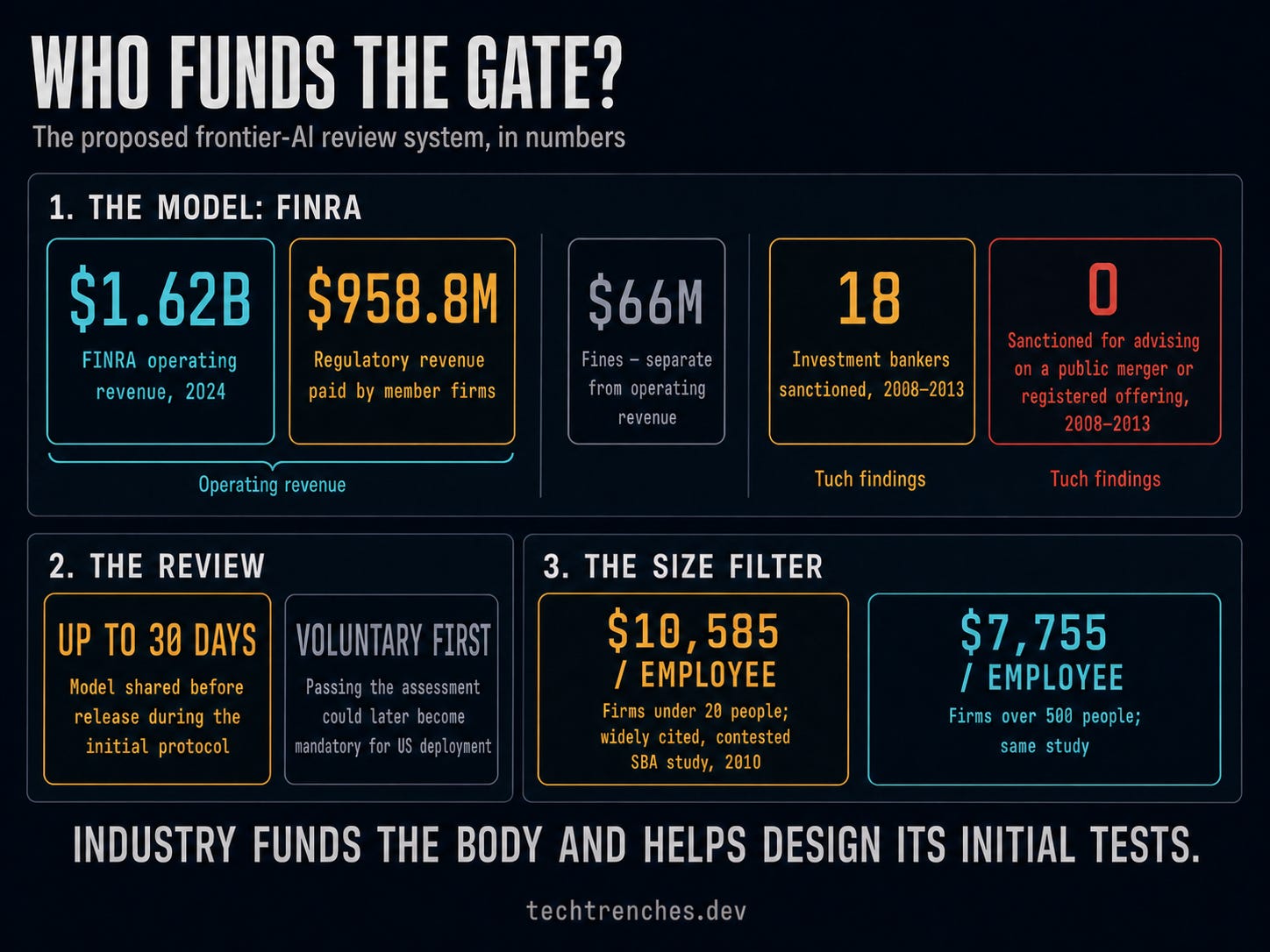
Start with the money. FINRA, the body Hassabis names as his model, is the self-regulator for American brokerages, funded by the firms it polices. Its 2024 financial report shows $1.62 billion in operating revenue, including $958.8 million in regulatory revenue paid by member firms. Fines added another $66 million separately. The firms pay the examiner’s salary. Andrew Tuch, a law professor at Washington University, read every FINRA disciplinary case from 2008 to 2013: its rules reach investment bankers, but across that window he found eighteen sanctioned, and not one for advising on a public merger or a registered offering. He called the self-regulation of investment bankers a failure. This is the model, presented as the safeguard.
The money is the first handle. The test is the second. Hassabis writes that the benchmark evaluations “would be developed in consultation with Frontier Labs,” and that only “eventually” would the Standards Body build the capacity to create its own held-out tests “independent of the Labs to prevent overfitting.” The labs help design the exam they will sit, and the independent version is deferred to a later date the proposal never fixes. A company that helps design the early questions has shaped the instrument before it is ever measured by it.
The threshold is the third handle. A model counts as “Frontier-class” when it crosses thresholds “determined by the Standards Body and regularly updated.” Hassabis says that board should seat “independent leading technical experts and open-source representatives,” not lab executives, and the body, not the labs, sets the line. But the labs fund it and help build the first tests the threshold is read against, so the incumbents hold real sway over the machinery long before any independent version exists. That is influence over where the line falls, not a seat that formally draws it, and it does not require bad faith. Hand any industry a regulator it funds and helps equip, and the outcome tilts the same way whether the people involved are cynics or saints. Three handles on one pump, and every one runs back to the firms the pump is supposed to regulate. The structure does the work.
The Thirty-Day Gate
The reason the structure matters now, and not as a civics-class abstraction, is the size of the number sitting on the other side of a delay. The four largest hyperscalers guided to roughly $725 billion in 2026 capital spending, largely directed at AI infrastructure. Hassabis proposes that Frontier Labs initially share models with the body up to thirty days before release. Once the protocol has proven itself, passing the assessment could become mandatory for deployment in the US market.
Thirty days. At that scale a thirty-day hold is a competitive window every lab has reason to fight over, and a body the industry funds and helps equip is the mechanism that decides whose thirty days get held and whose do not. But money is the smaller motive. The larger one is on the other side of the Pacific. Chinese open-weight models now sit within striking distance of the Western frontier, and they ship as weights anyone can download, run, and keep. I traced that gap and why it barely shows up where engineers actually work in an earlier piece. A released Chinese model is a lever nobody can pull back, and a US gate can deny it formal deployment in the American market but cannot stop it releasing everywhere else. A gate framed in the language of national security still does two jobs regardless of anyone’s intent: it gestures at a real adversary, and it locks the American market onto the companies that hold the closed frontier. The safety case carries real weight, which is what makes it the load-bearing half of a structure whose other half is a moat. The conflict sharpens further if the state also takes equity in the companies it regulates, a risk worth naming given reported talks over an OpenAI stake.
The Exam Filters for Size
Say the body is honest. Say every person on it is incorruptible and the equity talks go nowhere. The structure still breaks the same way, because a compliance regime is a fixed cost, and fixed costs are a tax that scales inversely with size.
A widely cited 2010 study for the Small Business Administration put federal regulatory cost at $10,585 per employee for firms under twenty people, against $7,755 for firms over five hundred. Those are economy-wide numbers, and contested ones, but the direction is the mechanism that matters here: the burden is heaviest where the headcount is smallest, because the paperwork does not shrink with the company. A thirty-day pre-clearance review, a compliance team to manage it, a policy staff fluent in the benchmark process the incumbents helped design, all of it is a rounding error for a lab that helped write the rules and a wall for everyone underneath. OpenAI grew its global-affairs team from three people to thirty-five in eighteen months. Cédric O, co-founder of the French lab Mistral, put the other side of it plainly while fighting the EU AI Act: Mistral was a company of roughly twenty people, he warned, and a heavy enough burden could kill it.
Now watch what the threshold does over time. “Frontier-class” is pegged to compute and capability benchmarks that the body will, in Hassabis’s words, regularly update. But the compute needed to hit any fixed capability falls fast. Epoch AI estimates pre-training efficiency roughly triples every year, so a line drawn today to catch the biggest labs sinks toward a garage team’s reach within a few years unless someone keeps raising it. Hassabis says the body will keep raising it. The capture thesis says the incumbents who fund the regime and supply its tests have every incentive to let the line drift down into their smaller rivals instead, and a provision to update the threshold means little when the people who benefit from a slow update are the ones underwriting the updater. The exemption Hassabis offers, that “non-frontier models, say from startups or academia, would be exempt,” is real only until the startup succeeds. Cross the line the body maintains, on an exam the incumbents helped design, and you enter a regime built to a scale you do not have. And the weights that let a startup or a rival catch up from below, the open ones anyone can run, are precisely what a “Frontier-class” threshold pulls into pre-clearance first.
This is where the closed-frontier labs stop being rivals. They compete ferociously on models and price, and they share one exposure none of them can fix alone: the open-weight model that needs no vendor at all. Here the safety case and the moat come apart. An American open-weight lab can submit to pre-release review like anyone else, so the regime does not stop domestic open weights, it taxes them, wrapping a thirty-day hold and a compliance burden around a model whose whole value was that anyone could take it and run it now. A US gate cannot prevent a foreign lab from releasing its weights. At most it can deny that model formal deployment in the American market after the file already exists everywhere else. The gate cannot prevent the foreign release most useful to its national-security case, but it can impose a delay and a compliance burden on the domestic open-weight competitor still within its reach. What it builds is a members’ club with a moving door, cartel-like in its structure: fierce rivalry inside, a shared wall against everyone outside, and the wall built first around the models nobody owns. The tell that this reads as capture and not only safety is Meta, big enough to sit inside that circle and choosing the other side of it, shipping among the most capable open weights the West has. A capability-pegged regime imposes a burden on Meta’s open-weight strategy that closed labs do not face in the same way, which is why Yann LeCun was warning about exactly these companies in 2023, calling their lobbying “a regulatory capture of the AI industry” and naming Altman, Hassabis, and Amodei while he did. He was aimed at Biden’s executive order then, but the concern is the same: closed labs shaping the rules that bind everyone below them.
What Would Make It Real
A model that can walk someone through a weaponized pathogen should not ship on a Tuesday because the quarter is closing. The instinct is sound. The design is captured.
Three changes would tell you the difference between a safeguard and a moat. Fund the body from appropriated public money instead of member fees, so the examiner does not draw his salary from the examined. Build the independent held-out tests on day one instead of “eventually,” so the labs are not helping design the instrument used to assess them. And put the threshold’s methodology, its update cadence, and the conflict-of-interest rules into statute or public rulemaking, so the line that defines who gets regulated is governed by a process nobody’s funding can quietly bend, rather than by a body the incumbents pay for. Hassabis’s proposal does none of the three. It funds the regulator from industry, builds the first tests with industry, and leaves the threshold to a body industry underwrites. FINRA was sold the same way, as the grown-ups policing their own so the government would not have to, and it shows that serious enforcement blind spots can persist for years inside an industry-funded self-regulator.
Cutting the labs out of the instrument draws the obvious objection: the people who know how to test a frontier model for weapons capability are the people who build them, and much of that expertise currently sits inside the companies being regulated. Expertise can be bought without being borrowed. Put those engineers on the body’s own staff, paid from public money and bound by the conflict rules any examiner carries. I would take that job, and so would plenty of engineers who spend their days shipping and reviewing this stuff. Pay enough, and qualified engineers will take the job. No one who stands to be measured should have a hand in building the ruler. Consultation with the company you are about to inspect buys access and calls it expertise.
So weigh the two halves honestly. The Chinese threat is real, the safety case is real, and a released model no one can recall is a real problem with no clean answer. Set all of that on one side. On the other side is a body the same labs would fund and help equip with its first tests, wrapped in the language of an adversary who genuinely exists. The pitch is that the labs are mature enough to be trusted with the machine that checks the labs. The tell is that they wrote the check.
Orwell gave us a Big Brother who watched you. This one is quieter and runs the other way. The big lab pays the man who signs the certificate that it is responsible enough to stay big.
"Orwell gave us a Big Brother who watched you." We now have systems which watch what we are given.
Interesting to compare with FINRA and other "members bodies" for regulation. In some ways this is even worse than a government regulator which is accountable to elected representatives.
The main issue, in both cases, is that the benchmarks and evals must be public, and available for the public to review and amend. Without this, we end up with the same issues we have in the financial system where decisions are made without explanation or review.
I will pin this article as an input when my planned Geometry of Work: Why AI Evaluations Don't License Safety Claims Constructive enters the production pipeline.