

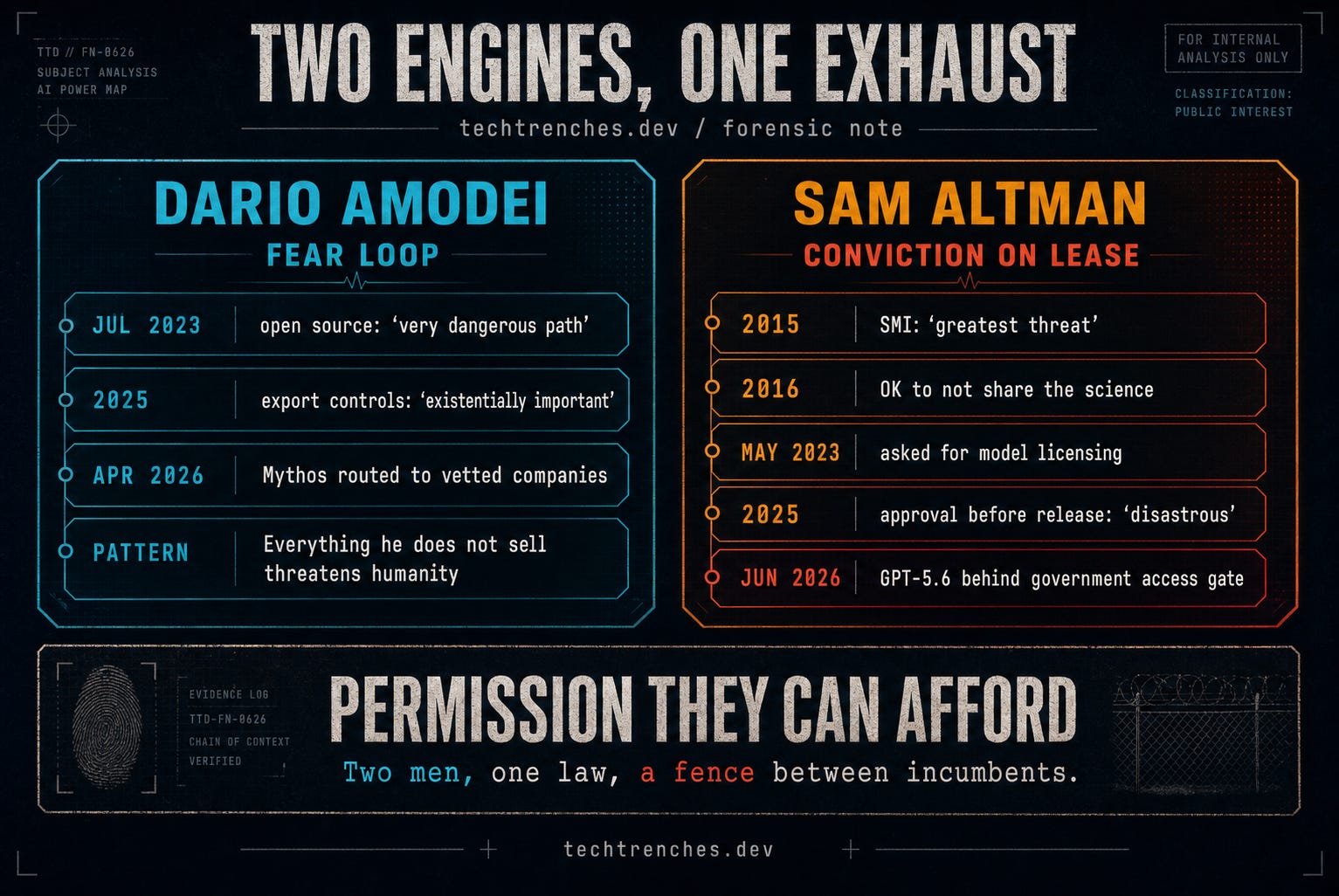
In June 2026 both men got handed the exact regime they had spent years asking for. Anthropic restricted Mythos in April through Project Glasswing, access limited to a vetted list. On June 26 OpenAI shipped GPT-5.6 to a small group of trusted partners, reported as roughly twenty organizations, each one approved individually by the US government, customer by customer, names submitted before access was granted. The first time an American lab released a frontier model through a government-managed access list. The scaffolding was an executive order signed June 2 that calls itself voluntary and states in writing that it creates no mandatory licensing or preclearance requirement. GPT-5.6 went through exactly that.
Both had spent three years telling Congress frontier models were too dangerous to release freely. In the summer of 2026 they were proven right in a sense they had not intended: the government agreed, and now decides who gets access to their product. Altman, whose model went behind the gate first, called the arrangement one that shouldn’t become the norm. The fence you lobbied for stops being the norm the moment you are the one standing behind it.
One of them has been afraid of the same thing since 2015. The other has believed six contradictory things in the same span. They run opposite operating systems, fear on a loop and conviction on a lease, and they arrived at that identical June by opposite roads. Opposite methods, one destination. That is the joke worth sitting with.
The man who is always scared
In July 2023 Dario Amodei told the Senate that open source models were going down “a very dangerous path.” His admirers share the clip now as proof of principle, because three years on the position has not shifted a millimeter. They are right that it hasn’t. They have not asked what the position actually points at.
It points at everyone else’s product. The warning lands on open weights, on Chinese labs that make export controls “even more existentially important than they were a week ago,” on Meta’s releases, on his own cyber model Mythos, which he announced in April 2026 was too dangerous to sell and then routed to vetted companies instead. The one thing it never lands on is the closed model Anthropic invoices enterprises for every quarter. Everything he does not sell threatens humanity. The thing he sells is fine.
I broke down the rest of that pattern in a separate piece, the withdrawn safety brake, the IPO filing, the warning published days after a raise that put the company near a trillion dollars, so I will not relitigate it here. What matters for this comparison is the shape. A fear that appreciates every time a rival ships for free, held so steadily that admirers mistake the steadiness for courage. He has pointed at every door in the building except his own, for three years, without blinking. Admirers call that integrity. It is aim. I loved this guy. What does that make me.
The man who is always right, retroactively
Sam Altman has no such steadiness, and that is his method. He will tell you what the next raise needs and the opposite of what the last one needed, and he has been doing it long enough that the contradictions now form a complete set.
The charter is where it starts. Early in 2015 he called superhuman machine intelligence “probably the greatest threat to the continued existence of humanity.” Months later he co-founded OpenAI as a nonprofit whose patents would be “shared with the world,” structured so profit could never capture the mission. A decade on he was writing in his own essays that the company now aims past AGI at superintelligence itself, the threat quietly rebranded as the product. Every promise in that charter has since been spent, one at a time.
Openness went first, and OpenAI’s own court filings show it was always meant to. In a 2016 email the company itself released, Ilya Sutskever wrote that “it’s totally OK to not share the science,” and Elon Musk replied “Yup.” The name outlived the promise by a decade. GPT-3 closed, GPT-4 closed, the word Open left hanging over the door like a sign for a shop that moved.
The structure went next, and this time the money signed the order in daylight. The nonprofit became a for-profit with the profit cap removed, and SoftBank tied tens of billions in funding to that conversion being finished on schedule. The firewall built to keep capital from steering the mission came down because capital asked for it in a term sheet.
With the structure gone, the rulebook flipped. In May 2023 Altman sat before the Senate and asked for a federal agency to license powerful models, while OpenAI, per reporting on the EU’s own files, lobbied privately to soften the Act it praised on camera. Two years later, now that OpenAI is the one who would need the license, he told the Senate that making developers seek approval before release “would be disastrous.” Same chair, same committee, inverted testimony, and the only variable that moved was his market share.
And the man asking for all of it swore he was not in it for the money. Under oath in 2023: “I have no equity in OpenAI,” he does this because he loves it. No direct equity, the careful version, the one the indirect holdings through his other funds slid neatly underneath. By late 2024 the reporting had him discussed for a stake near seven percent, around ten billion dollars at the valuation of the day, on top of those holdings he had carried quietly the whole time. For love.
On jobs he ran the full loop himself, selling the world the line that engineers were finished and then announcing, once the freeze landed on real people, that he was “delighted to be wrong.” I followed that bill to the people who paid it elsewhere. Here it is one more entry: sold retail, refunded with a smile, no name signed to the correction.
I never loved this one. Call it one for one.
Two engines, one exhaust
They are not the same man and they do not sell the same way. One is a compass welded to the competition, fixed on whoever ships next. The other is a weathervane bolted to a fundraising calendar, pointing wherever the quarter pays.
Walk out to where the money is, though, and the two roads pour into one lane. Both want a world where putting out a frontier model takes permission. Both want that permission granted through a process a near-trillion-dollar company can absorb and a free project cannot. The scared one gets there through fear that never rests, the slippery one through principles that never last, and they end up at the same regulator’s door asking for the same key. The product on the shelf is identical: permission they can afford and you cannot.
You are meant to pick one. The doomer who at least takes the risk seriously, or the builder who at least believes in abundance. Decline the casting. Choosing either has already conceded that the two men who got richest selling it are the adults in the room. The consistent one and the inconsistent one ended in the same lobby, asking for the same law, because that law was the only thing either of them reliably wanted.
Where I sit
So let me tell you where I land in their grand dangerous future. I am an old, gray, bad-tempered engineering manager who still reads every diff. I write code with one vendor’s model and review the plans with another’s, and I change my mind about which is which the moment the bill or the quality moves. Whatever license regime these two are drafting, it falls on the lab that trains the frontier model, not on the guy renting it by the token who can switch providers between lunch and dinner. It does not reach me. I am the customer, and the customer can leave.
So pass the law, gate the releases, make the frontier a club with a membership fee only the incumbent can pay. The day one of them decides this article earned me a ban, a Chinese open-weights model I can run on my own hardware will save the career of one bitter, complaining developer, and the part that actually ships will not notice the difference. From where I sit the capability barely moved a generation ago, benchmarks aside, so banish me and I will sulk over to whatever Google put out this quarter and keep going.
That is the punchline under all of it. They spent a decade selling the world a danger that was always out there, in the open models and the foreign labs and the uncontrolled release. The only thing their fence keeps out is the other one standing on it. Two men, one law, and neither of them is afraid of you. They are afraid of each other, and they would like you to pay for the fence between them.
Sue me. I will read the complaint in Kimi.
If you go sulk in a corner somewhere, take is with you.
Do you worry about the Chinese open weight models doing bad things with your data?