

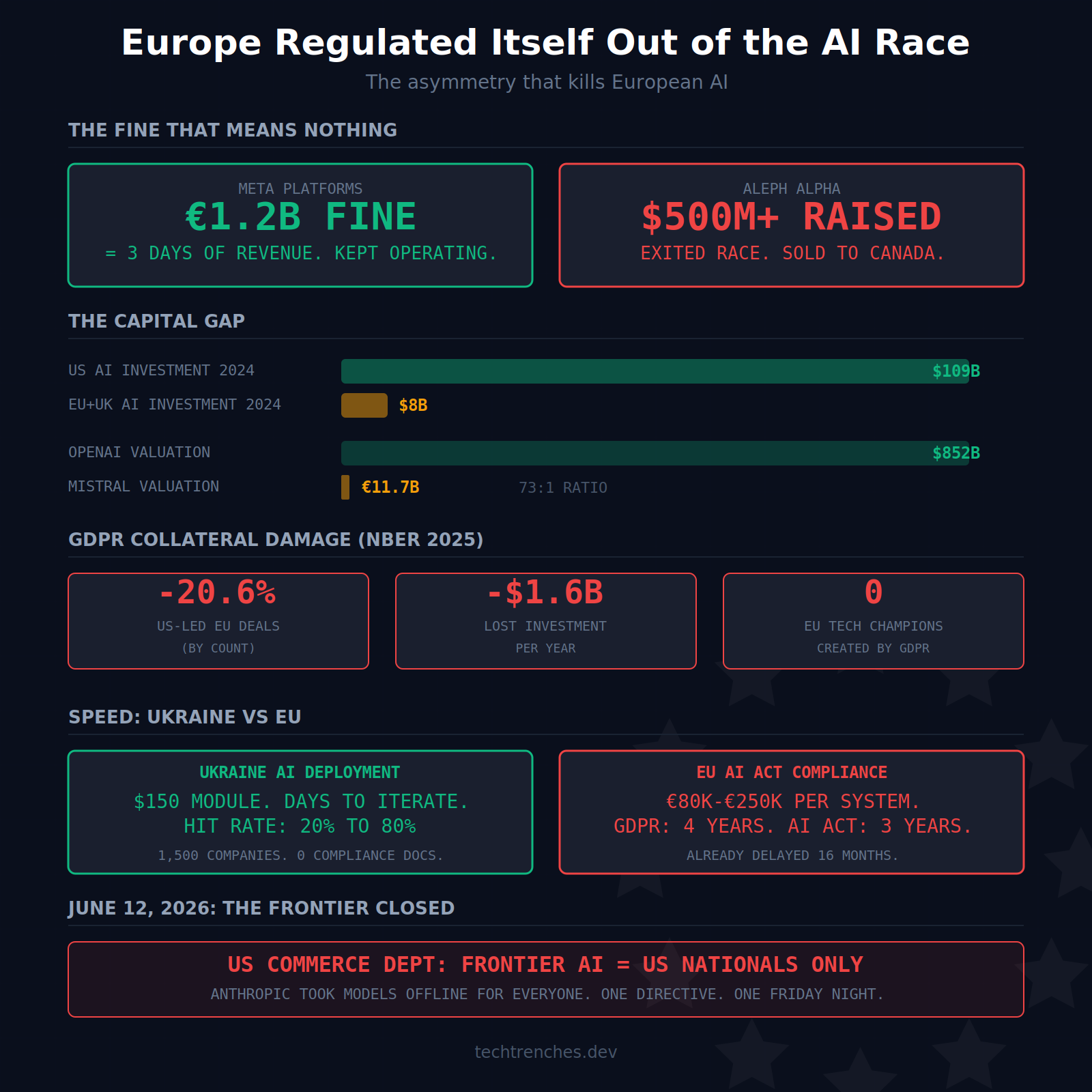
In May 2023, Ireland’s Data Protection Commission fined Meta €1.2 billion for transferring European user data to the United States. The largest GDPR fine in history.
Meta generated $200.97 billion in revenue in 2025. The fine equals less than three days of revenue. Meta adjusted its legal transfer framework to the new EU-US Data Privacy Framework and kept operating.
In mid-2024, across the border in Germany, Aleph Alpha announced it was exiting the foundation-model race. The company had raised more than $500 million from Schwarz Group, SAP, Bosch, Hewlett Packard Enterprise, billed as Germany’s answer to OpenAI.
CEO Jonas Andrulis told Bloomberg the math didn’t work. Just having a European LLM wasn’t a viable business model. The primary cause was competitive: GPT-4, Claude, and Gemini left no room. But regulatory compliance costs compound an already impossible position.
By October 2025, Andrulis stepped down. By April 2026, Canada’s Cohere acquired what was left at a combined $20 billion valuation. Germany’s flagship AI company is now a division of a Canadian one.
Three days of Meta’s revenue, a dead German foundation-model shop, and GDPR is not new at this.
The Precedent
GDPR took effect in May 2018. Cumulative fines have since approached €6 billion. The top recipients are American and Chinese companies: Meta, Amazon, TikTok, Google. All of them paid and kept operating. Not one left the European market.
A 2025 NBER paper measured what happened next: after GDPR took effect, US-led venture deals in the EU dropped 20.6% in count and 13.2% in dollar amounts. Roughly $1.6 billion per year in lost American investment, concentrated in exactly the kinds of young, data-intensive startups that would be training today’s European models.
The Draghi Report delivered the verdict: no EU company with a market capitalization above €100 billion has been created from scratch in the last fifty years. Every US company valued above €1 trillion was founded during that same period.
US private AI investment in 2024 hit $109 billion. The EU plus UK combined raised approximately $8 billion. Of 147 European unicorns founded between 2008 and 2021, forty relocated to the US. The fastest-growing AI company in Europe, Lovable, is built by a Swedish team but registered in Delaware. You can build in Stockholm, but you incorporate where the checks clear.
Brussels didn’t start from a level playing field. Twenty-seven languages, shallow capital pools, and risk-averse investors did plenty of damage first. But regulation is the one factor the EU chose to add on top of every other disadvantage. GDPR did not create a single European tech champion. Its most visible consumer outcome is a cookie banner that annoys 450 million people every time they open a website.
Brussels is about to aim this model at AI. Mistral is the one company that can’t ignore it.
The Only Boxer in the Ring
Mistral is the only European shop that even pretends to play in OpenAI’s league, backed by ASML’s €1.3 billion check in September 2025, valued at €11.7 billion. OpenAI closed a $122 billion round in March 2026 at an $852 billion valuation. The ratio is roughly 73 to 1.
Mensch would not have a company without Macron, and that’s not an insult, it’s the mechanism. Macron’s personal endorsement, a French military AI framework deal, an Nvidia data center partnership blessed at VivaTech, and Europe’s largest industrial investor writing a €1.3 billion check.
Strip the state support and you have a company with roughly $400 million in annual revenue competing with an $852 billion one. Markets don’t produce that outcome, governments do.
On GPQA Diamond, the hardest reasoning benchmark, Mistral Large 3 scores 43.9%. Gemini 3 Pro scores 91.9%. On the Artificial Analysis Intelligence Index, Mistral ranked in the bottom half as of early 2026, below DeepSeek V3.2.
Europe’s champion is losing to the companies Europe is trying to regulate. Mistral CEO Arthur Mensch told the French National Assembly in May 2026 that Europe has two years to avoid becoming America’s “vassal state,” criticizing the stacking of GDPR, copyright legislation, and the AI Act as a system that favors American giants who can absorb compliance costs without noticing.
Mensch is right about the diagnosis. But the sharpest contrast isn’t between Europe and America. It’s between how fast Europe can build and how fast it actually does.
What Speed Looks Like
The sharpest illustration of what AI development looks like without compliance overhead isn’t in Silicon Valley. It’s in Ukraine, where I live and run engineering teams.
A company called The Fourth Law makes an autonomy module that costs around $150 per unit in its cheapest configuration. The drone locks onto its target and flies the final approach without human input, immune to radio jamming. Hit rates jump from 20% to 80%.
A CSIS report confirmed the pattern: AI-enabled navigation raises engagement success from 10-20% to 70-80%. Instead of eight or nine drones per target, one or two are enough.
CSIS documented the approach: small models trained on small datasets, running on cheap chips, designed for fast retraining as battlefield conditions change.
No conformity assessments, no technical documentation packages, no risk management frameworks. The feedback loop is measured in days: a module ships to a brigade, data comes back, the model gets retrained, next version ships.
Brave1, the government defense tech cluster, supports over 1,500 Ukrainian tech companies. More than 300 AI innovations registered. Over 70 deployed on the front lines.
I wrote recently about how AI’s infrastructure appetite is starving Ukraine’s drone supply chain. That was about resources. This is about regulation. The EU is writing rules for AI systems that would qualify as high-risk under its own classification. The same class of systems Ukraine deploys in weeks and funds with a fraction of what Mistral spends on compliance lawyers.
Nobody in Kyiv is asking whether their autonomous navigation module has an adequate risk management system under Article 9 of the AI Act. They’re asking whether it hits the target.
The AI Act excludes military systems. So the part of the stack that’s been stress-tested under artillery fire is the part Brussels doesn’t regulate, while it drowns civilian use cases in paperwork.
The Rules Hit Where They’re Easiest to Enforce
The EU AI Act threatens fines of up to €35 million or 7% of global revenue. For Mistral, at roughly $400 million in annual revenue, first-year compliance for a single high-risk system runs €80,000 to €250,000.
The compliance invoice doesn’t care about your revenue. A startup with five engineers pays the same auditor as Meta.
In a 2023 survey of over a hundred EU AI startups, 33% believed their systems would be classified as high-risk. The European Commission assumed 5 to 15 percent.
American companies have a third option: withhold features. Apple held back Apple Intelligence. Meta sat on multimodal Llama for the EU. Google quietly slid Gemini’s launch by a few quarters. None of them argued with Brussels. They just downgraded the product for 450 million people.
Chinese companies face even less friction. Italy banned DeepSeek in January 2025 for refusing to acknowledge GDPR jurisdiction. No global financial penalty. DeepSeek remains accessible via VPN with no EU entity to enforce against.
TikTok received a €530 million fine in May 2025 for illegal data transfers to China, appealed, and continues operating. ByteDance is valued between $550 and $600 billion in secondary market transactions. The fine is less than 0.1% of the company’s value.
Brussels noticed.
Brussels Heard the Message. Too Late.
In May 2026 alone, the EU postponed its own high-risk AI deadlines by over a year, expanded SME exemptions, relaxed GDPR provisions for AI training data, and announced a €200 billion investment program. You don’t postpone your own law by two years because it’s going well.
But timing is the problem. GDPR took effect in 2018. The capital flight began immediately. Eight years of underinvestment can’t be reversed by a program announced in 2026.
According to Revelio Labs data reported by ScienceBusiness, France saw a net outflow of 45% of its AI researcher base in 2025 even as Mistral was scaling. The country that hosts Europe’s best AI company is losing researchers fastest.
I wrote before that some guardrails aren’t anti-innovation. I stand by that. AI companies that generate child abuse material should face criminal prosecution.
There’s a version of this where the EU says: don’t build dangerous things. That’s not what happened. What happened is: don’t build anything unless you can pay someone to document that it’s not dangerous.
I’ve seen this before. I wrote before about the EU promising Ukraine a million artillery shells and delivering half, nine months late.
Brussels loves the phrase “AI sovereignty.” In practice, sovereignty means the ability to build and run your own systems. The EU runs its AI on American models, assembles its hardware from Chinese factories, and relies on Ukrainian soldiers for the security that lets it hold regulatory hearings. That’s the sovereignty it’s defending.
The Gift Europe Won’t Unwrap
On June 9, 2026, Anthropic launched Claude Fable 5 to the public. Its most capable model, sharing weights with Claude Mythos 5, the version withheld for vetted cyber-defense partners.
Three days later, on Friday, June 12, the US Commerce Department sent Anthropic an export control directive: cut off Fable 5 and Mythos 5 from all foreign nationals, including those living inside the United States, including Anthropic’s own employees. Citizenship is the line. A green card holder who has lived in San Francisco for a decade, who works at an American company and pays American taxes, is cut off.
Anthropic said it believes the order may rest on a misunderstanding. Then it took both models offline for everyone because it has no way to verify every user's citizenship. A model that launched on Tuesday as the most capable public AI was gone by Friday night.
Older Anthropic models keep running. The frontier just got a citizenship requirement.
One directive, one Friday night, and the model is gone for everyone. Do that three more times and you’ve restructured who can work on frontier AI globally.
Those “AI sovereignty” slide decks that have been gathering dust in Commission offices since 2021 are not hypothetical anymore. Yesterday it was Fable 5. Next time it might not come back.
Brussels will publish something. Probably several things. A position paper, a roadmap, a working group with a three-year mandate. What it won’t do is ship a model.
Europe can build. GDPR took four years from proposal to enforcement. The AI Act took three. AI moves in quarters.
Ukrainians understand something that Brussels hasn’t learned in five years of watching this war. You don’t inherit capability. You build it while something is trying to kill you, or you don’t have it when you need it.
The text of the rules is the same for everyone. The bill for following them isn’t. Either Brussels never ran that spreadsheet, or it did and hit Send anyway.
The Fable 5 directive should settle one question that Europe has been avoiding since 2022. The United States is not a technological ally. It is a competitor that will restrict access to its best tools the moment it decides to. Europe needs to stop writing rules for American products and start building alternatives before the next Friday night directive takes away something it can’t replace.
It’s painful to watch alliances that held for decades fall apart in a few years. It’s worse to watch from a country that’s paying the price for that collapse.
"The sharpest illustration of what AI development looks like without compliance overhead isn’t in Silicon Valley. It’s in Ukraine, where I live and run engineering teams."
As I read this part, I thought, 'well, of course.' It makes total sense that, in my opinion, one of the most valuable and substantive SubStacks on AI for the coding professional, is authored by someone living and working in Ukraine.
I have always looked forward to your posts -- now, even more so!
We've had fascism in (fading) living memory here in Europe, we know when to distrust money teaming up with power. The US of AI will have to learn the hard way. Tragically, for the entire planet.