

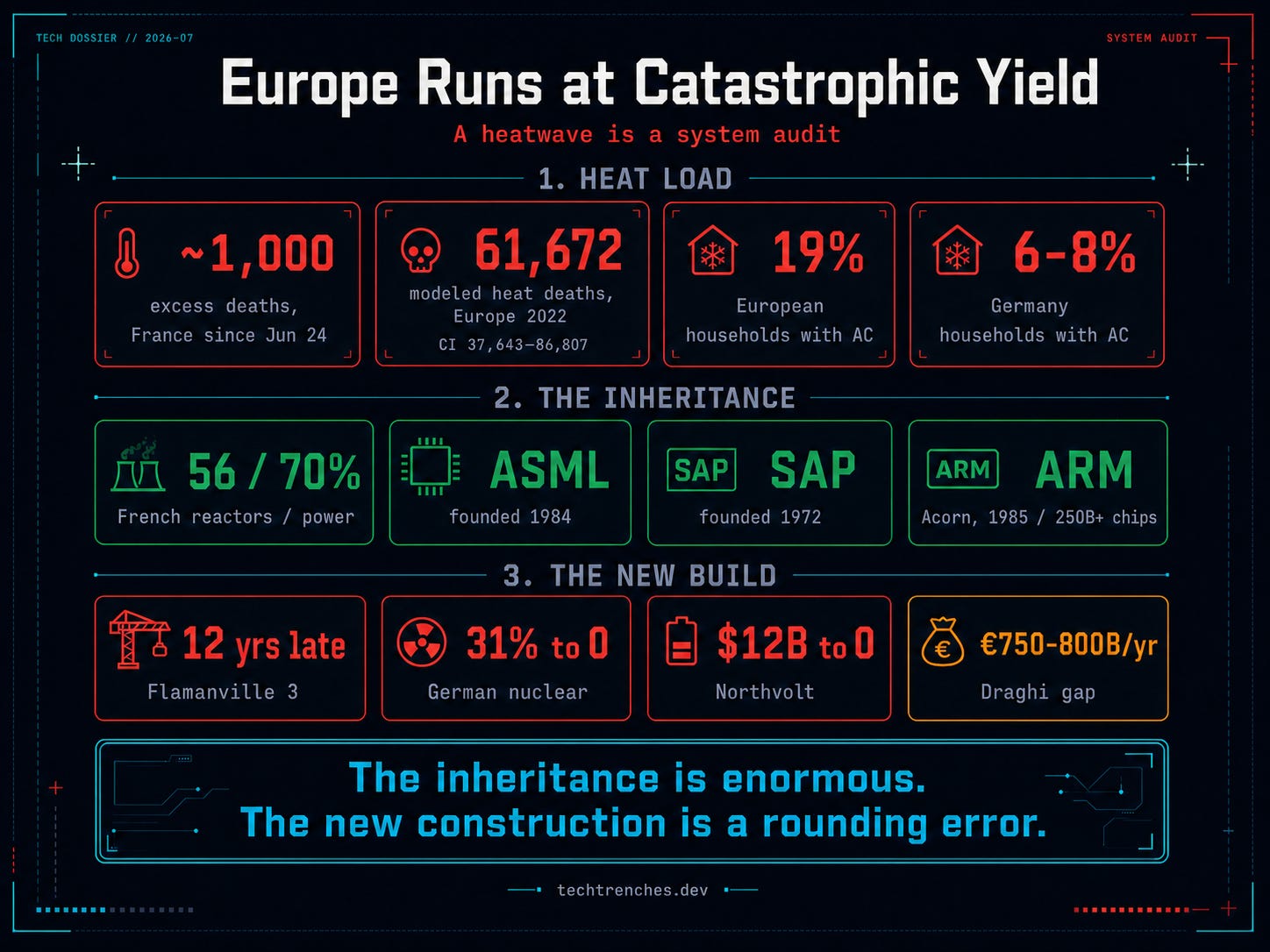
On June 24, the Louvre and the Eiffel Tower cut their opening hours. Paris banned weekend street drinking and pushed Pride to September. By Sunday, Santé Publique France had counted around 1,000 excess deaths since the 24th, preliminary and unconsolidated, with a warning that the figure will climb as data from care homes and private residences arrives. The overwhelming majority were over 65. Many died at home. June 24 was the hottest June day France has ever recorded, a national average of 30°C, with parts of the country past 40.
The summer of 2022 produced an estimated 61,672 heat-attributable deaths across Europe, a modeled figure from ISGlobal and Inserm with a confidence interval from 37,643 to 86,807. Italy carried roughly 18,000. The number is not new. The continent has watched it arrive every few summers and chosen, each time, not to fix the thing that would lower it.
Approved to Death
The appliance that stops most of this moves heat through a wall. Around 19% of European households own one; in the United States it’s close to 90%. Germany sat near 3% a decade ago and is still only around 6 to 8%. Every country on that list can afford the unit and can’t get permission to hang it on a wall.
In Italy, external units on protected buildings fall under the Codice dei beni culturali, where the Soprintendenza can take 120 days to rule and the answer is often no. France stacks a town-hall permit, a co-owners’ vote, and in a protected zone a sign-off from the Architecte des Bâtiments de France, who can send the unit somewhere it won’t be seen. Spain treats the facade as common property under the Ley de Propiedad Horizontal, where a visible unit needs a three-fifths vote of the owners. The objection is always the same, the look of the wall, and it already has a finished answer. A Dutch firm sells a color-matched enclosure that hides the unit and bolts on without tools, Barcelona’s own ordinance requires exactly that kind of concealment, and New York’s landmarks commission has governed it for years. The cover exists. The rule that would mandate it instead of banning the unit is the thing nobody writes.
A heatwave kills the elderly indoors, and the binding constraint is a review about whether the box is visible from the piazza.
A Heatwave Is a System Audit
The input is one of the largest economies on earth. The output is dead pensioners and a 400-euro fix nobody is allowed to install. When the heat comes you see what the system actually protects, and it protects the facade. This is not a marginal problem the system can be forgiven for missing. The summer of 2003 killed more than 70,000 people across Europe, and every serious heat season since has run into the tens of thousands. The continent has buried a small city’s worth of its elderly each bad summer for twenty years and still optimizes for the wall. That instinct, guarding the form and skipping the outcome, is not a quirk of housing law. It is the whole machine, and the air conditioner is only the version where you can count the bodies in a week. The reflex that guards the facade and lets the tenant die is the one that stopped building anything new, and the inheritance it has been living on is running out. You can see the same refusal in the things Europe once built better than anyone, starting with the power that keeps the lights on.
The Lights Are Fifty Years Old
France runs on 56 nuclear reactors poured in a single fifteen-year burst after the 1974 Messmer plan, still about 70% of its power, built for a forty-year life and now mostly past thirty. That timing wasn’t a French quirk. About 62% of every reactor operating on earth was connected to the grid between 1973 and 1992. Nuclear power was a one-generation construction project worldwide, and the generation that built it has retired. The one attempt to extend the French fleet, Flamanville 3, began in 2007 at 3.3 billion euros for a 2012 finish and reached the grid in December 2024, twelve years late at over 13 billion, four times the budget. The first working reactors of that exact design ran in China and Finland, not France.
Germany did the opposite of building. On April 15, 2023, it shut its last three working reactors, Isar 2, Emsland and Neckarwestheim 2, completing a phase-out that took nuclear from 31% of German electricity in the late 1990s to zero, in the middle of an energy crisis. And the thing meant to replace it, Europe doesn’t make either. China supplied 98% of the EU’s solar panels in 2024 and holds about 85% of the world’s battery manufacturing capacity. The continent that electrified itself two generations ago now buys its energy future from someone else and bans the air conditioner that future was supposed to run. Germany, having shut the reactors, leaned on Russian gas until the war forced it off, and now pays the highest household electricity prices in the EU, about 40 cents per kilowatt-hour against 11 in Hungary. The same slide from leader to buyer shows up in the one industry Europe still calls its own.
The Battery Bet Went to Zero
The car industry last set the world’s standard with diesel, and that ended the morning American regulators caught Volkswagen running software that gamed the emissions test while the real engines put out nitrogen oxide up to forty times the legal limit, September 2015. Since then Europe chases. Chinese brands went from 1% of the European EV market at the start of the decade to nearly 10% by early 2026. German market share inside China fell from 24% in 2020 to 15% in 2024. Seven in ten of the electric cars built on earth now come from China, which also controls about 85% of battery production.
Europe’s one serious answer was Northvolt, founded in 2016 by two former Tesla executives, more than 14 billion dollars raised, valued at 12 billion, the designated champion that would keep battery manufacturing on the continent. Its flagship gigafactory in northern Sweden never reached a fraction of its target, roughly one gigawatt-hour of output against a goal of sixteen. It lost a 2 billion dollar BMW order in 2024, filed for bankruptcy protection in the United States that November, and went fully bankrupt in Sweden in March 2025. The valuation went from 12 billion to nothing.
The defense base is the same story told in shells, which I’ve traced before: a continent that promised Ukraine a million rounds and delivered half, restarting production lines it had spent years letting close.
The Crown Jewels Are All Old
Strip out the things Europe now imports and the things it gave up, and what remains is a short list of companies the world genuinely cannot replace. Every one of them is old. ASML, founded 1984, is the sole maker of the lithography machines that print every leading-edge chip, including the accelerators the entire AI build-out runs on, each one selling for more than 200 million dollars. SAP, founded 1972 by five engineers who walked out of IBM, is still the largest enterprise-software company on earth. The ARM architecture in nearly every phone was first run at Acorn in 1985 and has now shipped in more than 250 billion chips.
What Europe has built since rides on infrastructure somebody else owns: Spotify, Revolut, Wise, Adyen, global scale with nothing underneath. The gap between launching a wrapper and building the foundation it runs on is the one Europe decided not to cross. ASML did build something irreplaceable this century, the EUV machine that shipped in 2017, but inside a company the prior generation founded, the way an heir renovates a house he didn’t buy. Four of the world’s fifty largest tech firms are European, a number its own regulation works to keep low.
The Invoice
Mario Draghi spent a year measuring this and reported it in September 2024. The output gap between the United States and Europe, per person and measured fairly, widened to roughly 30% over two decades, and about 70% of it is simply that Europe now produces less for every hour worked. Real income per person has grown almost twice as fast in the United States since 2000. The R&D gap with the United States runs to hundreds of billions of euros a year. Europe’s biggest research spenders are still its carmakers, where America’s are now its tech giants. Closing the gap, Draghi calculated, would take an extra 750 to 800 billion euros a year, proportionally larger than the Marshall Plan. To put that in buildable terms, it is on the order of sixty Flamanville reactors a year, just to stop falling further behind. That is the invoice for a generation that maintained instead of built.
The inheritance is enormous. The new construction is a rounding error.
Twenty People, or 450 Million
I run a team of up to twenty. Brussels runs 450 million. Scale doesn’t correct a bad objective function. It multiplies it.
The worst state available to any organization is the one where the operating goal quietly becomes “leave me alone” and the system stops optimizing for anything at all. Run that for forty years and the inheritance spends itself down with nothing built to replace it.
The same weekend the death count came out, 63,000 French households lost power. The heat and the outage landed in the same week, which is the normal way infrastructure fails, several things at once. The block I live in stayed lit through the same kind of night, and I’ve spent four years on which systems hold under that pressure and which fold.
What You Can’t Inherit
Everything Europe is spending down was inherited: the wealth, the engineering, the reactors, the companies. The one thing that cannot be inherited is the ability to act when systems fail, and it only comes from having watched them fail. My building has no OSBB, the homeowners’ association that organizes around other buildings. It has a private management company as useless as the rest of them, so the residents put money in directly, a generator and batteries with an inverter that keep the elevators, the water, and the heat running through a blackout. Nobody waited for the state.
Ukraine ran this experiment at the scale of a country, and not because the state planned it. When Russia started hitting the grid in late 2022, the government failed at distributed energy the way governments do. It kept rebuilding the big Soviet-era plants Russia kept destroying, the Trypilska station outside Kyiv among them, repaired after the first winter and then gone in a single April 2024 strike. The distributed grid that would have survived this never got built, so people stopped waiting for it. They wired their own buildings off the grid and ran their own generators, the same three layers as my block, a few million times over. I am not going to call it a winning move. Energy terror is the one card Russia still has that works, because the grid is the thing you cannot fully defend. What changed is the cost of using it. Our long-range reach has grown enough that going after the grid again means taking the same back, and we have years of practice at living through it. They have not.
I can afford my building, and a generator is not a national solution. We hate the things, the noise of them and the diesel coming through the window, and we run them because the alternative is the dark. Nobody here romanticizes any of it. The difference between a Kyiv block that solved this and a Paris one that didn’t isn’t money or engineering, because Europe has more of both than we do. It is that we have buried people, and that changes what a system is willing to tolerate. Ukraine runs on European money and weapons, which is exactly why I can say this plainly. If the line we hold goes down, Europe meets its first real crisis in generations, and the heatwave was the rehearsal.
Europe still has the engineers and the factories. What it stopped doing is building, and you cannot inherit your way back into knowing how. The covers will still be on the shelf next summer, and the rule that puts them on the wall will still be unwritten. We would not have waited twenty years for permission to install an air conditioner if our old people were dying in the heat.
Great article, as always! Some notes:
Electricity prices here, in Hungary, are 'fake'. The previous party created a rule that allows residential users to buy electricity on this price for a given yearly amount. Over that you pay the market price. Commercial users pay the market price. Market price is around the double of the residential price.
We also have an excemption from the EU, so we can buy russian gas. The price of the gas is also fixed for the residential users. However this rule does not help a lot. It just kills utility companies' profitability and the utility grid is slowly degrading. There are also still poor regions in the country where people die of heatwave or freeze to death in their own property.
A totally fair critique of Europe (and the UK).
There is too much regulatory capture at all levels and too much focus on preserving the past and not enough on building the future. In fact I'd go as far as because Europe allowed their ability to build things to be hollowed out by the interests of capital, they've forgotten how to build anything of scale.
The USA isn't far behind on the curve. The USA outsourced most of their capabilities so now find themselves with nothing to work with. A lot of cities are simply not designed for the climate they now find themselves in and don't have the money to make improvements with property tax not bringing enough revenue to keep the current infrastructure maintained let alone build new stuff. No to mention the rampant NIMBYism in most cities.
Also lot of housing was built quickly post WW2 and was never expected to still be standing 80 years later. Modern building code means that something a simple as replacing a broken water heater or replacing a cooker can turn into a $$$ remodel when the inspector notices your electrical panel isn't to code or your gas line is in the wrong place.
Governments at all levels still haven't learned what good software engineers learned a long time, that the bulk of the work (and the cost) is always in the maintenance phase and the more you build the more you have to maintain and the system is just not setup to handle that.