

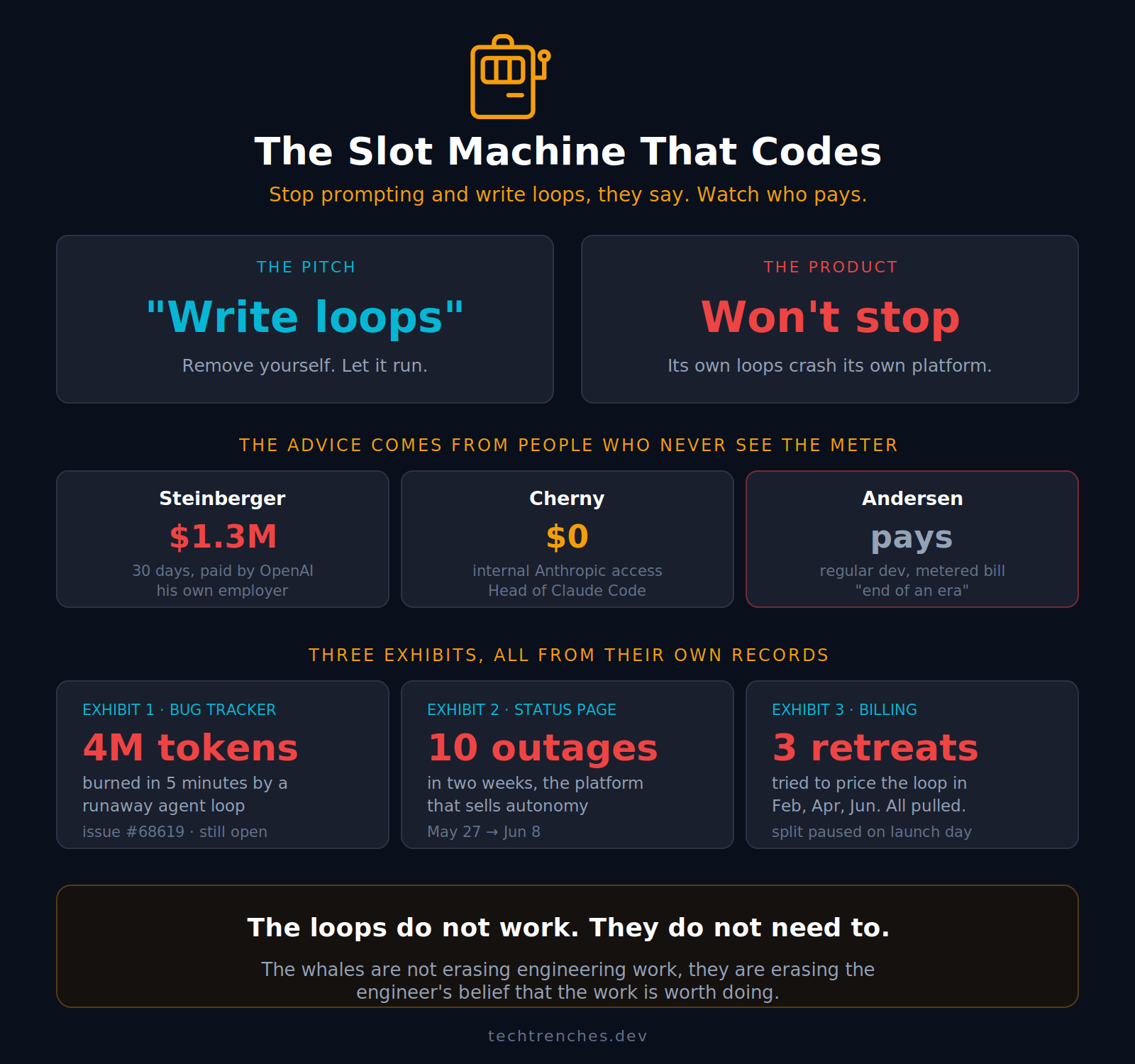
On June 8, a developer named Ed Andersen posted that since the GitHub Copilot billing change, he had lost the urge to write code for the first time in his adult life. He described watching money leave his bank account every time he asked a machine to think. Then he wrote the line that matters: “End of an era for regular developers.” The people who keep coding, he said, will be the ones with effectively unlimited token budgets.
The same week, two of the most-quoted men in AI coding told everyone the opposite. They said the budget was no longer the point, because soon you would not be the one spending it. You would build a machine that spends it for you, and walk away.
Peter Steinberger spent thirteen years building PSPDFKit into a PDF engine running on a billion devices, sold it, then built OpenClaw and joined OpenAI to work on agents. He posted that you should stop prompting coding agents and start “designing loops that prompt your agents.” Boris Cherny, who runs Claude Code at Anthropic, told an audience that he does not prompt Claude anymore. He has loops running that prompt Claude and decide what to do. “My job is to write loops,” he said, and called this the transition the rest of us would make by year’s end.
Andersen and the two evangelists are describing the same room from opposite sides of the table. One of them just walked out of the casino with empty pockets. The other two are the house.
What They Are Actually Selling
The pitch is that you have been promoted. You stop prompting and start writing the system that prompts, one rung up the ladder of abstraction: punch cards, assembly, C, high-level languages, and now loops. It is the next rung on the ladder I have watched Cherny climb for a year, from ninety percent of his code written by Claude, to one hundred, to not touching the prompt at all. A reply under Steinberger’s post took it to the end: the next step is a loop that designs the loops, and then the agents lay you off for being dead weight. He was joking, and correct about the direction.
Whether a loop can work is settled. Who pays when it does not is the part nobody is pricing in.
Steinberger ran the largest public version of this. A three-person team ran roughly a hundred agents for a month and he posted the bill: $1.3 million in tokens across 7.6 million requests in thirty days, dropping to around $300,000 with Codex’s Fast Mode off. He framed it as proof that autonomy works at scale. It does, when someone else holds the meter open, and OpenAI was paying. The number describes his employment, not your budget.
Whose Money Is On the Table
Cherny is in the same position from the other vendor: he works inside Anthropic with internal access no customer has. Neither he nor Steinberger runs a loop, opens a bill at month’s end, and feels it. I cannot prove their insulation is why they advocate this, and I am not calling them cynical. But advice to let the machine spend freely reads differently when the people giving it are not the ones paying.
Gergely Orosz, who writes The Pragmatic Engineer and is no AI skeptic, reduced it to its two real preconditions: the people who have a use for loops are the ones with “unlimited AI token budgets,” or the ones who feel prompting holds them back, usually because they have the budget. Which collapses two conditions into one. Orosz frames his own answer as a preference, that he is more than content prompting, but for most developers it is not a preference. The budget decides for them, and the budget is shrinking.
Andersen is the one who pays. The moment metered billing arrived, the magic turned into a number leaving his account. The narrative is free only for the people producing it. Uncapped consumption already did this to the companies that believed the first version of the pitch, and the same pattern is back under a new name.
What Is Actually Under the Hood
It is worth asking what the thing actually is, this loop expensive enough that no one will meter it and no one who praises it pays for it. It has a name and a shape. The technique is called Ralph, invented by Geoff Huntley, and at its core it is one line of bash that feeds the same prompt to a coding agent over and over until it stumbles into something that compiles. Huntley named it after the Simpsons character and after 1980s slang for vomiting. He has written that the script sometimes makes him nauseous, that it is cursed in how it was built and how cheap it is, and that he worries he upended his own profession by proving it was possible.
The foundation is a while-loop that brute-forces an answer through repetition, built by a man unsettled by his own creation. Anthropic shipped a Ralph Wiggum plugin for Claude Code, and Cherny has said he uses Ralph. When the head of Claude Code says his job is to write loops, the loop is a vomiting Simpsons character in a terminal, running on top of a platform that has to stay up for any of it to mean anything.
Someone Is Always Watching It
That platform does not stay up. Outages are normal, every service has them, and competent teams design around them with retries, fallbacks, and multi-provider routing. That work is done by a human, and it does not stop being necessary because you wrote a loop.
Take the company whose head of Claude Code says he no longer touches the code, and look at its own status page for the two weeks around when he said it. Opus 4.7 threw elevated errors on May 27, twice, then again on May 28, June 1, June 7, and twice more on June 8. On June 2, a single failure took down multiple models across claude.ai, the API, the Console, and Claude Code together for close to six hours. Claude Code degraded again overnight on June 3. On June 5, an outage of nearly three hours hit nearly every model at once and came with public concern about potential customer data exposure, neither confirmed nor ruled out by Anthropic. June 8 brought three separate incidents in a single day, across Opus 4.8, Opus 4.7, and Haiku 4.5.
The June 2 outage is the one to sit with. Contemporaneous reporting traced the trigger to Claude Code’s sub-agent system, where agents spawned child agents in a loop that would not terminate, draining token quotas in minutes and forcing Anthropic to push an emergency refund to affected accounts. The pattern did not stop there. On June 15 a user filed issue #68619 on Anthropic’s own bug tracker, titled “Subagent spawning and subagent pattern bugs trigger infinite recursion, infinite token usage.” Anthropic tagged it critical. The body reports subagents spawning child agents fifty levels deep, ignoring the environment flag that is supposed to disable forking, and one observed session where the recursive tree burned four million tokens in under five minutes, an entire Pro Max 20x five-hour budget gone before the user could react. The regression shipped on or around June 10, and as of this week the issue is still open. The company that sells loop-driven development is the company whose loops will not stop.
A loop is only as autonomous as the service it calls. When that service returns errors, or spawns agents until it falls over, something has to notice and stop it. On the pitch, that something is the loop. In practice it was Anthropic’s own engineers watching the dashboard, on the product whose lead says he writes loops instead of code. The frequency does not prove autonomy is impossible. It proves the unattended part of “leave it running unattended” was never real, even at the company selling it.
The Strongest Version of the Case, and Why It Folds
None of that means the loop is useless, and the honest move is to say where it earns its keep. For bounded work with a binary check at the end, it does, and the flaky-test case is the cleanest version I have seen. In the same thread, a developer described pointing an agent at flaky end-to-end tests under one rule, do not touch app code, only stabilize the test, looping until the suite passed twenty times clean. It took their CI flake rate from around 12% to under 2% over a weekend. Orosz called it a sensible example, and it is. It worked because the task was narrow, the check was a passing suite, and verification was cheap enough that the loop converged in a weekend instead of burning forever. A tool with a clear stop, the same category as a linter or a compiler. And that is the tell. Developers have automated their work for decades without anyone declaring the keystroke obsolete. What is being sold now is not the automation, it is the story around it: that this tool is a paradigm you graduate into by removing yourself, rather than a faster way to do a narrow job you still define and check. The story has a cost that lands before the tool ever does. It teaches engineers that wanting to read their own code is a phase to grow out of.
Addy Osmani, who has done the most to systematize the technique, warns that the same loop gives opposite results depending on who runs it, swinging on whether you are token rich or token poor, and that the whole thing rests on a verifiable stopping condition. His advice is to build it like someone who intends to “stay the engineer,” not the person who presses go and leaves. The autonomy has quietly evaporated: the engineer stays, the stopping condition is hand-set, and the rich-versus-poor caveat is the budget argument again.
The Ralph enthusiasts tell you to cap the infinite loop at ten or twenty iterations to start, because the alternative is an agent re-running forever on a problem it cannot close. The “infinite self-prompting loop” has a human-set ceiling, a human-defined success check, and a human deciding the budget before it starts. That is the job you already had, with a new title.
A Casino Only the House Can Afford
Outside that narrow case, the pitch to remove yourself and let it run is an invitation to feed a machine that bills you for every pull whether it produces anything or not. The narrow case is the exception they show you. The meter is the product.
Self-hosting does not buy you out of it. Run the model on your own leased GPUs and the per-query cost does not vanish, it moves onto your own infrastructure bill, which is the trap I traced in another piece.
The house wins either way, even when it cannot decide how to charge you. Anthropic spent this year trying three times to move agent usage out of its flat subscription: a terms-of-service clampdown on third-party OAuth in February, an outright ban on tools like OpenClaw on April 4, and a full metered split for the Agent SDK announced in mid-May for June 15. Days before the split, the Wall Street Journal reported that OpenAI was weighing drastic token price cuts to pull customers off Claude. With a price war landing and its own IPO already filed, Anthropic paused the split on the day it was meant to take effect, “nothing changes for now.” Three attempts to price the agent layer, the third one paused on launch day, because agents cost more than the subscription can absorb and the company cannot raise the price in the middle of a fight. The meter is still running. They just cannot agree on how to print the number. The croupier does not gamble with his own chips. Steinberger plays on OpenAI’s money, Cherny on Anthropic’s, and the machine they are demoing throws errors every other day on its own status page.
Andersen saw it the moment billing arrived. The only players left, he concluded, will be the ones with bottomless budgets, and those players are the house. The loop was going to bill you for the privilege of watching it try.
I have argued before that AI works only when humans with real engineering judgment surround it, and that without them it scales your worst habits instead of your best. Cherny and Steinberger are two of the most listened-to voices in the field, and the habit they are scaling is the one where the human stops reading the code. The loops do not work, and they do not need to. The whales, the same players with the budgets nobody else has, are not erasing engineering work. They are erasing the engineer’s belief that the work is worth doing, and from what I can see, that one is landing.
Setting aside for a moment my opinion that coding agents are turning software development into one big cluster fuck; what I have yet to hear anyone discuss with any seriousness, is what the plan is for after all this code that no one has looked at, is put into production. Inevitably, code will do what code does, and someday will break; or requirements change and will need to be modified; or underlying infrastructure changes, requiring it to be refactored. Is the plan to spin up a few dozen token-guzzling agents to "pull the lever" on the slot machine until, by random chance, a working "fix" (that no one will look at, nor understand) falls out?
This is not the next evolution in software development, like a new compiler, or a new language -- both of which are deterministic tools that are written by and understood by humans. These are probabilistic "black boxes" being used to replace the knowledge, understanding and coding skills of a human being.
This is a devolution, not an evolution.
"End of an era for regular developers" is what absolutely worries me. Is now banned by law for developers to develop WITHOUT code agents? Are we always competing with the rest of developers in a race of LOC and if you don't release 10000 per day you lose? Is impossible to do open source just for the pleasure/pain of doing it without agents?
I think that we bought not only the productivity narrative. We brought also what I called the bully narrative: a guy without code agents can not "compite" with a guy with code agents. They converted the software development in a zero sum game in which the first one, takes it all.
That is what I don't understand how the people is accepting so fast. Google was not the first web search. And when it appeared it did not follow any of the supposed mainstream patterns of yahoo, astalavista... Etc. Even if your product is just a clone, don't have to be the first clone to be successful or die.
Yea guys, you can write from scratch faster than any developer. It is a machine, of course that does it faster. But remember the Fable of the tortoise and the hare. The fastest don't win the race if it starts playing around without direction.
I get the boost of endorphins you are getting using agents, but I can not understand in professional software engineers that stop coding when they do not have an agent. Makes me wonder if they are the ones that should elect a different profession instead to tell the not looping ones that they are left behind.
They are winning battles that never started in the first place.