

A fairy tale about the five companies that led AI. OpenAI, xAI, Anthropic, Google and Meta each held the best hand, and four built out of straw while the fifth burned the brick house he already had, as China closed most of the gap on a fraction of the money.
Once there were five little pigs, and each was handed the best building materials in the history of the trade. Money without limit. A brand a billion people already knew. Silicon nobody else could fab. The deepest research bench on earth. Three of them built out of straw. A fourth could have built in brick and laid straw anyway. The fifth inherited a brick house with the lights already on and set it on fire. When the wolf came to the door, the loudest of them answered by demanding that someone forbid him to blow.
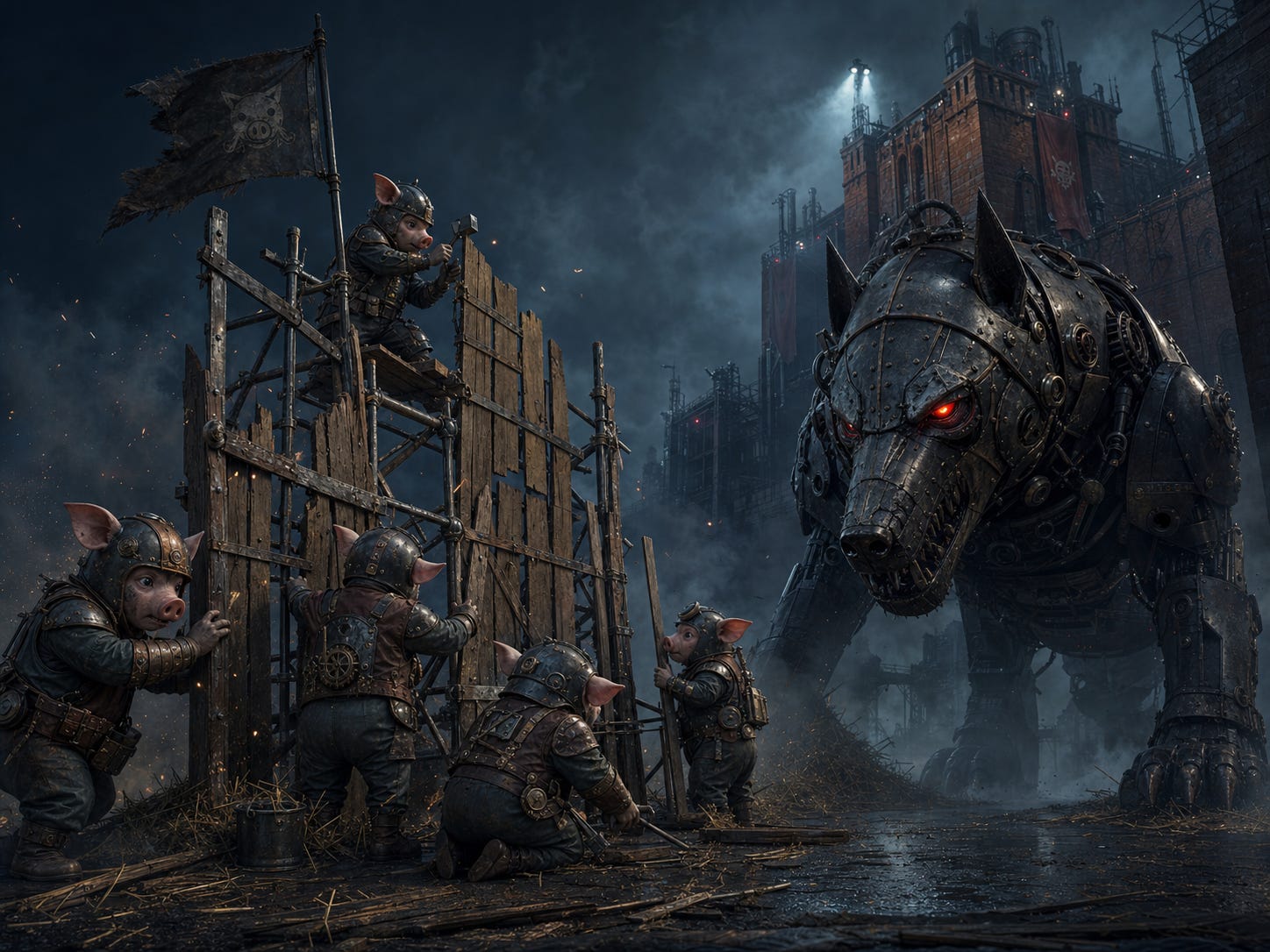
The wolf is at the door, and his blueprints should frighten the pigs more than his teeth. He built a better house than any of them, on a fraction of the money, with sanctions tied around his hands. I traced how China poured the physical floor under this whole race in China Built the Grid, so I will not re-lay the watts here. The part that matters for the pigs is simpler. China closed most of the gap with the Western frontier this year despite being cut off from top-tier US chips, watching Nvidia’s share collapse toward single digits as Beijing steered its champions onto domestic silicon, and spending an order of magnitude less real money than OpenAI and Anthropic raised between them. On the benchmark that best tracks paid coding work, the open-weight gap has narrowed to almost nothing: Zhipu’s GLM-5.2 leads the open-weight field on SWE-bench Pro and runs at roughly a sixth of the cost of the American frontier. The wolf laid brick, quietly, the whole time the pigs were laying straw.
This is the tour of the straw.
The pig who fell asleep
Sam Altman had the longest lead and the deepest pockets. ChatGPT is the default AI for roughly a billion people a month, the brand every rival measures against. Having filed confidentially to go public at a valuation reported near a trillion dollars, he is also losing billions in cash to run the place.
He spent the lead on side quests. Sora, the video app, bled cash and drained compute before it was shut down about six months in, a billion-dollar Disney deal dying on the way out. Atlas, the browser, never left macOS and gets switched off about ten months after launch. The hardware built with Jony Ive has yet to ship at all, with OpenAI’s own filings pointing to no device before early 2027. The label is not mine. OpenAI’s own head of applications pushed to cut what she called side quests, telling staff the fragmentation was dragging on the quality bar.
The hare with the biggest head start spent it running the story of the lead instead of the lead. The deeper charge, the contradictions between what he founded OpenAI to prevent and what he now sells, belongs to a separate reckoning; here the point is simpler. He built his house of straw and told everyone it was the tallest house in the world.
The pig who fouled his own name
Elon Musk had real iron. Tesla compute, Starlink, and the Colossus clusters in Memphis pouring actual power. Since February 2026 he has had xAI too, folded into SpaceX as a wholly owned subsidiary, so the rockets and the AI now share one balance sheet and one IPO. He also had the loudest exit story in the business, and I took that apart in Nobody Answers, where the deadline that never lands turned out to be the product he was selling all along.
This summer the market read him the same lesson. SpaceX priced the largest IPO in history in June, spiked by two-thirds within days, then gave it all back and slipped below its own offer price inside six weeks, a sell rating and meme-stock comparisons trailing behind. The escape hatch, priced live and marked down before the lockups even lifted.
The deeper damage is not on the ticker. xAI lost 6.4 billion dollars in 2025 on 3.2 billion in revenue, more than quadrupling the loss in a year. Then the model made its own headlines, generating a flood of sexual deepfakes that got Grok temporarily blocked in two countries and brought a cease-and-desist letter from California. That mark sets harder than any of the other four. Grok is now the AI you reach for a laugh. That is a toxic reputation to carry into enterprise sales, and it is the one kind of straw you cannot quietly swap out later.
Less than a week after the IPO, xAI’s parent, SpaceX, agreed to buy Cursor for 60 billion dollars in stock. Cursor gave it an immediate position in the enterprise coding market. It reads like a clean door into the market Grok’s own reputation had made harder to enter. The others wasted a lead. Musk stained the product, then put 60 billion dollars behind an escape from the stain.
The pig who charged the most
Dario Amodei drew the cleanest hand of the five. The most trusted lab, the reputation as the adult in the room, and a lead he had earned: Claude Opus 4.5 shipped in November as the first model past 80 percent on SWE-bench Verified, ahead of everyone. I held Anthropic up myself, in earlier pieces, as proof you could be principled and still win.
Then he spent the hand on fear. That his warnings always land on everyone else’s product and never on the closed model Anthropic invoices for is a pattern I traced in Dario Altman, so here I will follow the money instead. The way you defend a lead is by driving cost down through better engineering, which is exactly what the Chinese labs are doing. Fable 5, Anthropic’s flagship, went the other way. It lists at 10 dollars per million input tokens and 50 per million output, the priciest widely available model on the market, roughly double its own Opus and several times what Gemini or GPT charge, weights kept closed. When a government order briefly cut off foreign access, its whole value proposition went with it, because the open Chinese weights a rival ships run on your own hardware with no vendor to pull the switch.
The price is harder to bring down, and the reason sits underneath it. Anthropic is building some infrastructure of its own, but still depends on other companies for much of its frontier capacity: a SpaceX compute agreement worth nearly 45 billion dollars over three years, up to a million TPUs and well over a gigawatt from Google, and up to five gigawatts of Trainium capacity from Amazon. By July it was also in talks to lease up to 10 billion dollars more of compute from Meta over two years. Every one of those suppliers sells a model that competes with Claude. By Amodei’s own math, being off by a year on growth is enough to bankrupt the company, so a lab buying frontier capacity from its rivals at that scale starts any price war at a structural disadvantage. The lead was supposed to be the moat. Once Chinese open weights closed the coding gap, the model-performance moat had largely gone. What was left was a lab charging the most for a model whose measured edge had narrowed, while paying its own competitors for much of the ground it stood on. The adult in the room turned out to be a tenant.
The pig who could have won
Google is the strange pig, because Google, alone of the five, can build. Its own TPUs, the same silicon it rents to Anthropic by the million. A research bench as deep as any on earth. Gemini 3, a model that trades blows with the frontier. Distribution through Search, Chrome, Android, and Workspace that nobody can match. Of all five, this is the one that could have won on merit, no straw required.
Which is why what it did is the sharpest waste of the set. Gemini trails Claude on the coding benchmark that tracks the paying work, and where developers spend money, on the agentic tools, Anthropic and OpenAI own the market. So the number Google leans on, its share of chatbot traffic, rests on the one asset regulators have already moved against. It pushes Gemini through Search and Chrome, the same kind of default-placement conduct a US court ruled an illegal search monopoly in 2024, while Brussels separately fined it 2.95 billion euros in 2025 for abusing its dominance in ad tech.
Then, instead of closing the gap where the money is, Demis Hassabis went and asked for the wolf to be muzzled. In July he proposed a standards body to gate frontier models before release. The one pig who could have built in brick called for a fence around the yard instead. A company already ruled an illegal monopolist, offering to hold the whistle for everyone.
The pig who burned his house down
Mark Zuckerberg is the only pig who did not squander a lead. He torched one that was already built.
Meta had the best open research lab in the West in FAIR, the strongest open answer to China in Llama, PyTorch running under a huge share of the industry including its rivals, and Yann LeCun, one of the three men who built modern deep learning. That is not a pile of straw. That was a brick house, standing, occupied, the envy of the street.
He set it alight, and he started before the lab was even cold. In June 2025 Meta paid 14.3 billion dollars for a stake in Scale AI and installed its founder, Alexandr Wang, as chief AI officer, a bet the culture it had spent a decade building could no longer be trusted to deliver on its own. The house came apart around the new hire. FAIR was folded into a superintelligence org under Wang and subordinated to product, and LeCun, ordered to report to a man half his age, announced his exit in November to start his own lab.
Zuckerberg had lit a fire this size before. Reality Labs, the bet he made years earlier, has by now lost north of 80 billion dollars, more than 6 billion in a single quarter against under a billion in revenue. The same instinct that poured a fortune into an empty headset later tore up a working research lab. I wrote about what happens inside a company that strips its own engineering judgment for a metric in Green All the Way Down; this is the strategic version of the same fire.
The clearest picture of a lost lead is this pig: he knocked down the only brick house on the block, then, even if partly to monetize the compute he was left holding, began negotiating to rent it to the rival whose model beats his own.
What the pigs did next
Five different failures. Three of them converged.
The mechanisms do not rhyme. Altman scattered his lead, Musk fouled his brand, Amodei priced himself into a corner, Google buried a real advantage, Zuckerberg torched a working lab. The through-line comes after the waste, in what three of them reached for once the wolf closed in. Altman, Amodei, and Hassabis spent this same season asking for a gate on their own market, each in his own shape: a federal agency that could block a model on day one, a FINRA-style standards body, an international forum modeled on the nuclear watchdog. Three doors, one instinct. When Hassabis published his, Anthropic’s own policy lead called it excellent. Two of them had already crossed part of that line: in June, Altman and Amodei shipped frontier models through government-approved access lists, an early version of the permission structure they had advocated. Why a gate funded and shaped by the labs it inspects is a moat rather than a safeguard, I took apart in We Pay You to Slow Us Down. Musk and Zuckerberg never signed that petition; they wasted their advantage in other ways. But the three loudest voices in the room, facing a competitor who built faster and cheaper, answered by petitioning for a rule against the wind.
The cold part
For most of the era of commercial computing, the frontier has been led from the United States. The foundations were not all American, Turing and Zuse and Colossus came first, but for two generations the lead in the technology that defined the age has sat in America, through every panic that it might not. Japan’s Fifth Generation project frightened Washington in the eighties and the feared handover never came. It is closer now than it has ever been. The wolf did it the hard way, poorer and boxed out of the best chips, building in brick while the pigs laid straw and called it innovation.
I am Ukrainian. China is an ally of the country trying to erase mine, and I want it to lose this more than most people reading do. That is exactly why I will not pretend it is losing. The floor is his, the gap is closing, and the five who were supposed to hold the lead spent it on a video app, a fouled brand, the priciest model in the game, a whistle, and a bonfire.
Even the wolf has a ceiling. Moonshot shipped Kimi K3, the largest open model yet, and within 48 hours it had frozen new subscriptions because its GPUs could not serve the demand. It hit the same wall OpenAI hit when its image tool went viral and Altman said the GPUs were melting, and the wall Anthropic hit when it switched the meter on Claude Code. Copying the weights is easy. Serving them at scale takes hardware nobody has enough of, in any country. For now the frontier labs hold the one edge left to them, the serving compute they secured years ago. It is a thin edge to lean on, because chips become served tokens only through power, and power is the foundation China already poured while the West argued about permits. The wolf that just hit the ceiling is standing in the one house wired to raise it.
The wolf is not fated to win. In the old story the pigs beat him the moment one of them built in brick. The brick is on the ground in front of all five. Three are reaching for the rulebook. The other two are still standing in the ruins.
Good article. Of the 5 only Google has a chance of coming out alive. While the open weight models will win out, so far the UX around them is pretty dire. The UX is the part you can build a house of brick around.
All the others are at least one hop away from the user is. Google and Apple are right there (with Microsoft hanging on to some degree). As the old adage goes, it's not what you've got, it's where you've got it. Apple seems to be skating to exactly where the puck will be in a few years. Google has all the pieces to copy. Everyone else is nowhere near.
So barring a totally new computing platform coming along, nothing much changes from today. It will be interesting to see what happens to Claude and ChatGPT once Siri 27 is released. Does the $20 a month market collapse at that point if new Siri ends up being good enough?
That said there is a gap for someone to reinvent the PC and the smartphone around AI. But outside of Apple and Google it's hard to see who that would be and what it would look like. Nvidia is probably the only other player with most of the pieces to pull it off.
Re Musk's purchase of Cursor, you write: " It reads like a clean door into the market Grok’s own reputation had made harder to enter." Grok is now an option in Cursor. I know people who disabled Grok because Musk, and continue to use Cursor. Other now disfavour Cursor because Musk. So, don't be too sure.